
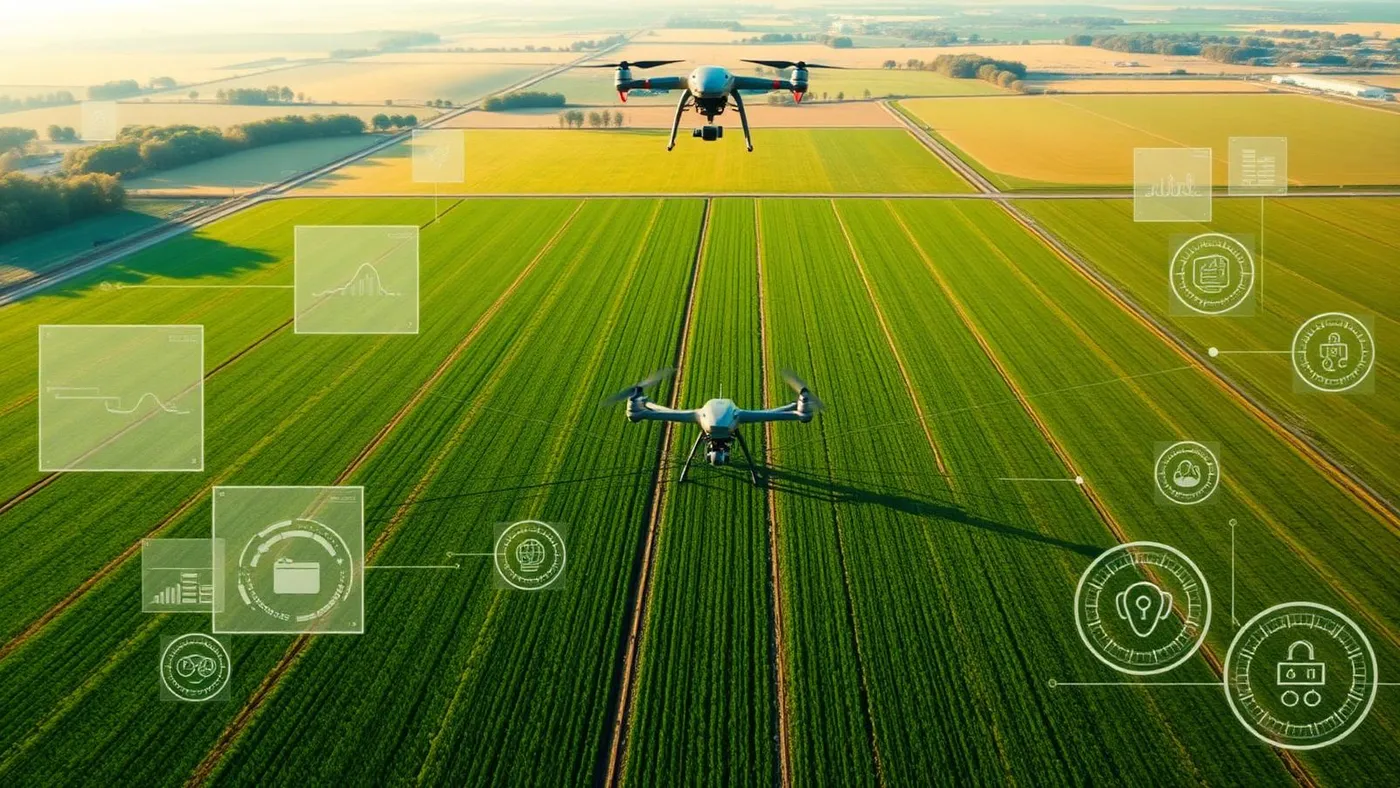
Sustainable Technological Solutions
Sustainability has stopped being just talk and has become efficiency engineering: reducing inputs per unit produced without giving up productivity. This guide covers the three pillars, the dispute between planned obsolescence and dematerialization, the role of agribusiness, the digital revolution, and precision systems.
There is a confusion that has delayed the conversation about sustainable technological solutions for decades: treating sustainability as synonymous with producing less. This reading turned the topic into a cost, a reporting department, and a slide at the end of a presentation. The correct reading is different and much more interesting for anyone running a business: sustainability is resource productivity — how much input you consume to deliver a unit of value.
Reducing input per unit produced is, at the same time, an environmental indicator and a financial indicator. Less wasted fertilizer, less pumped water, less burned diesel, less idle servers, less code rework: each of these items appears on the income statement and the ecological statement on the exact same line. This is why companies that take the topic seriously rarely speak of “sacrifice.” They speak of waste.
This article organizes the discussion into five interconnected blocks: the three pillars of sustainability (including the cultural dimension, almost always forgotten), the dispute between planned obsolescence and dematerialization, the role of agribusiness as the largest laboratory of sustainable production, the digital revolution that Embrapa helped bring to the field, and, finally, precision systems — the layer where data turns into decisions and decisions turn into input savings.
The thesis that runs through the text is simple: technology is not inherently sustainable. It only becomes sustainable when it is designed to reduce the resource intensity of a real process, and when that gain is measured. Without measurement, what exists is narrative.
The three pillars of sustainability — and why culture is factored in
The classic definition of sustainable development was born in the Brundtland Report (1987): the current generation must meet its needs without compromising the ability of future generations to meet theirs. Notice the verb — meet needs. It's not abstinence, it's meeting needs with intergenerational responsibility. From this principle derive the three pillars that support any solution that aims to be sustainable.
Physical Limits & Replacement (Environmental Pillar)
Measures consumption per unit produced and ensures that the rate of use does not exceed the local ecosystem's regeneration capacity. A truly green solution reduces the water and carbon footprint at the source.
Social Pillar
Local language, ease of use, and respect for the knowledge of the operating community.
Economic Pillar
Fast payback and financial viability that allows the model to scale without permanent subsidy.
Direct Return on Investment
Without financial viability, the model does not repeat itself. It requires direct savings of inputs that cover the cost of investment in hardware and software within a reasonable timeframe.

The pillars are not independent
The most common mistake is optimizing one pillar and destroying another. Replacing a productive matrix with a less polluting one, but which eliminates the income of an entire community, solves the environmental and breaks the social. Automating a process to cut costs and, along the way, increasing energy consumption solves the short-term economic and aggravates the long-term environmental.
Therefore, the evaluation must be done as a system, with the three indicators on the same screen. It is exactly this discipline — looking at stocks, flows, and side effects — that Donella Meadows systematized in Thinking in Systems, cited in the references.
Planned Obsolescence × Dematerialization
These two forces pull the economy in opposite directions. The first multiplies matter to sustain revenue. The second multiplies function on the same matter. Understanding which side your product is on is one of the most honest strategic exercises a technology company can do.
Planned Obsolescence
It is the design decision that deliberately shortens the useful life of a product: a critical part that cannot be replaced, a glued-in battery, the absence of replacement parts, new software that freezes the old device, or simply a style that ages quickly (perceived obsolescence).
The environmental cost is double: raw material is extracted again, and a product that still worked is discarded. The social cost is too: electronic waste usually ends up far from those who profited from the sale.
Dematerialization
It is delivering the same function with less matter. A smartphone absorbed a camera, GPS, recorder, agenda, printed map, calculator, radio, and flashlight. A SaaS replaces a CD, manual, local server, and technical visit. A services marketplace replaces an idle fleet.
The important caveat: dematerializing is not magic. The bit runs on physical infrastructure. Datacenters consume energy and cooling water; the gain is only real when the material savings exceed the added energy cost — and this needs to be measured, not presumed.
| Dimension | Planned Obsolescence | Dematerialization |
|---|---|---|
| Revenue logic | New sale every short cycle | Recurrence by use and update |
| Use of raw material | Grows along with revenue | Decouples from revenue |
| Relationship with the client | Transactional; friction in replacement | Continuous; value grows over time |
| Waste generated | High and growing (e-waste) | Low, concentrated in infrastructure |
| Main risk | Regulation, reputation, and right to repair | Energy cost and dependence on connectivity |

The middle path: designed durability
Between destroying value early and pretending that digital has no weight lies a third way, championed by Braungart and McDonough: designing for repair, modular upgrades, and material return. In software practice, this translates to backward compatibility, lean code that runs on old machines, architecture that doesn't force the customer to change hardware with each version, and infrastructure sized by real usage — not by imagined peaks.
Want to measure your business's resource efficiency?
At Shinier Accelerator you structure hypotheses, define indicators, and validate sustainable technology initiatives with a method — from diagnosis to roadmap.
Discover the AcceleratorAgribusiness and sustainable production: environment and macroeconomics in the same hectare
No Brazilian sector so clearly exposes the relationship between input, productivity, and impact as agribusiness. It is, at the same time, one of the country's largest sources of foreign exchange and one of the largest users of land, water, and energy. This dual condition makes the field the place where sustainability needs to be solved with engineering, not with a slogan.
From a macroeconomic perspective, the reasoning is direct: a good part of the fertilizers used in Brazil is imported and priced in dollars. Each percentage point of input saved per ton produced improves the producer's margin, reduces the chain's exchange rate exposure, and decreases the pressure on the trade balance. Input efficiency, here, is economic policy applied inside the farm gate.
The environmental lever: intensification instead of expansion
There are two ways to produce more: open up new areas or increase the yield of the existing area. The first transfers the cost to the ecosystem. The second — sustainable intensification — uses technology to raise productivity per hectare, with practices such as crop-livestock-forest integration, no-till farming, biological nitrogen fixation, integrated pest management, and recovery of degraded pastures.
The economic lever: cost per bag, not total cost
The producer who only looks at the total cost tends to cut inputs at the wrong time and lose the harvest. The metric that matters is the cost per unit harvested. A management practice that spends the same but yields more is more sustainable than one that spends less and harvests much less. This distinction separates input savings from simple cash tightening.
Traceability became a market requirement
International buyers and large retailers have begun to demand proof of origin and socio-environmental compliance. This pushes the chain towards digital registry systems — exactly the type of problem we solve in projects like Jade LIMS, for monitoring the agro supply chain. Traceability has ceased to be a differentiator and has become a condition for market access.
Digital revolution in the field: the role of Embrapa
The transformation of Brazilian agriculture in recent decades was not a market accident: it was the result of long-term public research. Embrapadeveloped cultivars adapted to the tropical climate, made cultivation in the Cerrado viable, popularized no-till farming, and consolidated biological nitrogen fixation — a technology that replaces a relevant part of nitrogen fertilizer with bacteria that do the job for free. Each of these fronts is, in essence, a solution of input reduction with productivity gains.
From mechanization to automation
The first wave replaced physical effort with machinery. The digital wave replaces decisions with evidence: autopilot, real-time operation monitoring, and telemetry that shows fuel consumption per plot.
Sensing and imaging
Satellite and drone imagery allow us to see variability invisible to the naked eye — stand failures, water stress, pest outbreaks — early enough to act with localized application instead of treating the entire area.
Predictive models
Historical series of climate, soil, and productivity feed models that suggest the planting window, disease risk, and optimal dose. The value is not in the algorithm, but in the quality of the field data that feeds it.
The real bottleneck: connectivity and usability
The available technology is much greater than the adopted technology. Spotty rural connectivity, interfaces designed for office analysts, and systems that do not talk to each other hinder adoption more than the price of the equipment. Those who build software for the field must assume three premises: work offline, fit into the operator's routine, and export data in an open format. This is the cultural pillar appearing as a technical requirement.
Precision systems: where data turns into input reduction
A precision system starts from a simple realization: no productive area is homogeneous. Soil, moisture, compaction, and history vary within the same plot. Applying an average dose to heterogeneous terrain means, simultaneously, wasting where it's not needed and lacking where it is. Precision corrects both errors at once — and that's why it shows up on both the environmental account and the margin account.

1. Collect
Georeferenced soil sampling, harvest maps, multispectral images, moisture sensors, and machine data. Without a reliable spatial base, everything else becomes an expensive guess.
2. Interpret
The data is crossed to generate management zones: clippings of the area with similar behavior. This is where the agronomist decides the criteria — statistics suggest, agronomy validates.
3. Apply
The prescription map goes to the machine controller, which varies the dose in real time. Sector irrigation, spraying with automatic section control, and variable-rate fertilization are the most mature applications.
4. Verify
The harvest map of the following season closes the cycle and answers the only question that matters: did the decision reduce inputs per ton harvested? Without this step, the system is a dashboard, not management.
Precision is not exclusive to agriculture
The same architecture — sensor, variability map, zone actuation, and verification — applies to predictive maintenance in industry, energy management in buildings, fleet routing, and even to software infrastructure, where well-calibrated autoscaling is literally a “variable rate” of servers. In all cases, the principle is identical: stop treating the heterogeneous as homogeneous.
How to measure if your solution is truly sustainable
Before announcing any gain, set up a panel with these five questions. If you cannot answer with a number, you don't yet have a sustainable solution — you have an intention.
- Input intensity: how much material, water, and energy per unit delivered — before and after the solution, on the same baseline.
- Rebound effect: was the efficiency gained returned to the environment or did it simply allow for more consumption? Efficiency gains without volume control usually evaporate.
- System boundary: does the calculation include the entire chain — equipment production, transportation, operating energy, and disposal — or just the convenient part?
- Payback: in how many cycles does the input savings pay off the investment, considering maintenance, training, and support.
- Real adoption: what percentage of the people who should use the solution actually use it after six months. Abandoned technology has a negative environmental impact, not a neutral one.
Conclusion: efficiency is the concrete form of sustainability
A truly sustainable technology solution is one that solves a real problem while structurally reducing the amount of physical resources needed to do so. It doesn't ask the customer to sacrifice the result in the name of the environment; it delivers more margin precisely because it stops wasting the environment.
When you separate the noise from the science, sustainability becomes what it always should have been: good engineering.
Referências
- BRAUNGART, M.; McDONOUGH, W. Cradle to Cradle: Remaking the Way We Make Things. The foundational book of regenerative design: proposes replacing the logic of 'reducing harm' with designing products whose materials return entirely to technical or biological cycles. View on Amazon
- LOVINS, A.; LOVINS, L. H.; HAWKEN, P. Natural Capitalism: Creating the Next Industrial Revolution. Reference on radical resource productivity — how to multiply the efficiency of inputs by four or ten while maintaining (or raising) the economic result. View on Amazon
- RIFKIN, J. The Third Industrial Revolution. Discusses the convergence between distributed energy, digitalization, and new production models — the economic background of dematerialization. View on Amazon
- DIAMANDIS, P.; KOTLER, S. Abundance: The Future Is Better Than You Think. Deals with dematerialization and demonetization: how a single digital device absorbs functions that previously required dozens of physical products. View on Amazon
- SLADE, G. Made to Break: Technology and Obsolescence in America. Historical investigation of how planned obsolescence was deliberately incorporated into industrial design in the 20th century. View on Amazon
- MEADOWS, D. Thinking in Systems: A Primer. Methodological foundation for seeing inputs, stocks, flows, and leverage points — indispensable for measuring sustainability without being fooled by partial metrics. View on Amazon
- MOLIN, J. P.; AMARAL, L. R.; COLAÇO, A. F. Precision Agriculture. Brazilian reference work on sensing, yield maps, variable rate, and the statistics behind management zones. View on Amazon (BR)
- EMBRAPA Digital Agriculture: Research, Development, and Innovation in Production Chains. Consolidates the state of the art of Brazilian field digitalization, from rural connectivity to predictive models. View on Amazon (BR)