
Don't build in the dark.
Prove your idea is profitable.
A Financial Feasibility Analysis reveals whether your startup is an expensive hobby or a scalable business. We project your costs, model CAC, margin, NPV, and IRR before you invest in the technology.
90% of startups fail because the math doesn't add up.
Many founders have brilliant ideas to solve real problems. But they forget to test the financial physics of the business.
If your Customer Acquisition Cost (CAC) is higher than the value generated (LTV), the faster you grow, the faster you will go bankrupt. If the addressable market (SOM) is too small, the startup has nowhere to scale.
Our Feasibility Analysis creates a financial digital twin of your startup to stress the numbers on paper before spending in the real world.
Blind Break-even
Not knowing how many paying customers are needed to pay the bills.
CAC vs LTV
Paying more to acquire the customer than the profit they leave in the company.
Short Runway
Running out of cash before finding Product-Market Fit.
Wrong Pricing
Charging an amount that doesn't even cover the variable costs of servers and support.
What we deliver in the Analysis
A complete X-ray structured in 4 fundamental pillars, resulting in a dynamic financial model ready for investment rounds (Pitch Deck).

Market
We size the real opportunity. How many people suffer from this pain and what is the maximum possible revenue?

Costs
Projection of all costs to operate: cloud servers, AI APIs, team, marketing (Burn Rate) and infrastructure.

Revenue
The heart of SaaS: Average Ticket, Acquisition Cost (CAC), Life Time Value (LTV), Churn Rate, and Contribution Margin.

Valuation
We evaluate the Net Present Value and the Internal Rate of Return. We answer the golden question: is it worth investing in this business?
Stop Guessing Your Startup's Future
The market is flooded with superficial "valuation calculators" that ask 5 to 20 generic questions and spit out a random number. That is not how professional Venture Capital works.
Applying traditional methods like Discounted Cash Flow (DCF) or standard market multiples to early-stage startups is a mathematical mistake. Without historical data, these models generate unrealistic projections that mislead founders and repel serious investors.
Our viability analysis is powered by a proprietary financial engine developed with extreme scientific and academic rigor. We do not guess; we stress-test your business model across hundreds of variables to prove your profitability before you write a single line of code.
The Danger of Superficial Spreadsheets
If your viability analysis fits in 10 questions, your startup is fundamentally exposed to blind spots in OPEX, Churn, and Commissioning efficiency.
Dynamic Projections
We model 10-year cash flows based on growth assumptions, not non-existent past data.
Probabilistic Scenarios
We calculate Optimistic, Realistic, and Pessimistic scenarios to mitigate market uncertainty.
Unit Economics First
Your valuation is derived from your true Customer Acquisition Cost and Lifetime Value.
We did the heavy math for you
We do not use basic templates. We operate a highly complex, interconnected financial engine composed of 4 distinct calculation modules. Every assumption you define cascades through the entire architecture to prove a positive Valuation and an IRR above 40%.
TAM
Total Addressable Market: Total revenue opportunity for a product or service.
SAM
Serviceable Available Market: The segment of the TAM targeted by your products and services.
SOM
Serviceable Obtainable Market: The portion of the market you can realistically capture.
Gm (Growth Mensal)
Monthly Growth Rate derived from the Compound Annual Growth Rate.
Net Growth
Real monthly growth after accounting for lost clients (Churn).
LT (Lifetime)
Average number of months a customer stays active.
LTV
Lifetime Value: Total revenue expected from a single customer.
Beyond Numbers: Strategic Alignment via NLP
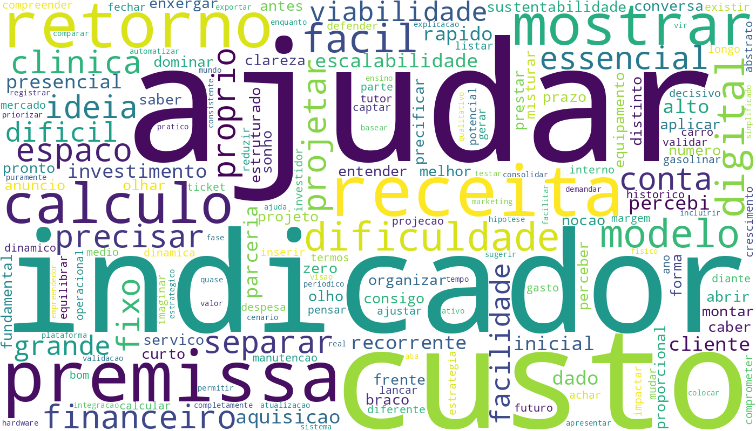
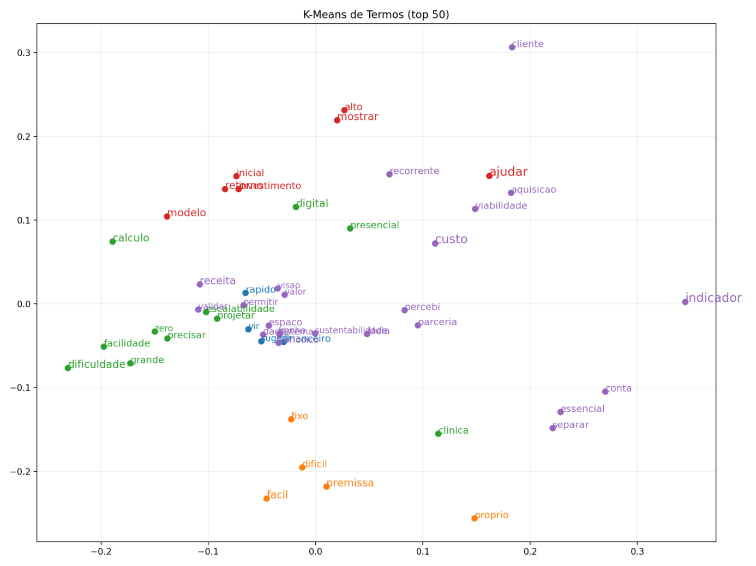
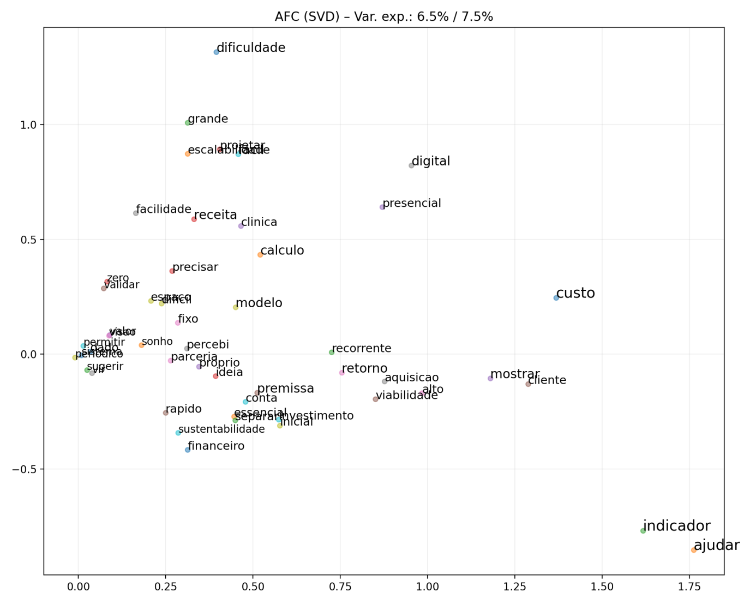
Numbers alone don't build startups; founders do. We use Python-based Natural Language Processing (NLP), the VADER algorithm, and K-Means clustering to analyze the alignment between your mathematical projections and your strategic discourse.
Sentiment Analysis (VADER)
We map your qualitative responses to ensure you are not overly optimistic about risky markets.
Semantic Priorities
We identify if your focus is correctly distributed between 'costs', 'indicators', and 'returns'.
K-Means Clustering
Your startup is classified into Operational, Strategic, or Financial maturity stages.
Blind Spot Detection
Similarity graphs reveal hidden disconnects between your pricing model and viability.
Spreadsheets Accept Anything. Execution Does Not.
We prove that our method is real. It's easy to twist numbers in a spreadsheet until the math works. But what guarantees your startup crosses the 'valley of death' is whether the plan is executable. When we reject a startup, it's not just because the math didn't close; it's because our NLP models detect fatal misalignments between your discourse and your actual capacity to execute.
output_wordcloud.png
output_kmeans_clusters.png
output_svd_afc.png
Don't Guess. Calculate.
The absence of structured financial planning and the lack of knowledge regarding key Unit Economics metrics significantly compromise a startup's survival, especially in the early stages.
Our framework provides consistent, market-tested indicators to objectively subsidize your strategic decisions. Whether you are preparing for an investment round (pre-seed) or just trying to figure out if your pricing model covers your server costs, we give you the exact numbers you need.
You own the plan. You can hire us to run this analysis and then take the validated execution plan to build on your own or with another accelerator. Stop hoping for profitability. Use our engine to structure your financial planning, validate your strategies, minimize risks, and know the exact moment to step on the gas and scale.
Data-Driven Decision Support
Reducing uncertainty in the early-stage ecosystem.
Everything you need to learn before hiring a tech professional
Understanding techniques, concepts, real cases, and digital literacy is the best way to avoid costly mistakes.
Explore full Accelerator catalogStartups we accelerated and scaled
More than code: we act on the strategic board and joint operational execution.

Geninhos
EdTech / AI"Elementary education platform with proprietary content and AI tutors designed to engage children in learning and update parents."
Still wondering if Shinier is the right solution for your startup?
No long boring meetings or lengthy forms. Answer a few questions on WhatsApp to qualify your project and connect with the right specialist.