No-Code
Ex: Glide.app
Ideal para protótipos rápidos e apps simples baseados em planilhas. Zero programação necessária.
Custos Glide.app:
- • Gratuito: até 10 usuários
- • Basic: $25/mês
- • Pro: $99/mês
- • Business: $249/mês
RápidoLimitado

Have you had a business idea for months (or years) but don't know where to start? This definitive guide will show you the 7 proven steps to overcome paralysis and finally turn your vision into a real project — even without experience or large investments.
According to global research, more than 70% of people have had a business idea, but fewer than 5% actually turned it into something concrete. The statistic is alarming, but it reveals an opportunity: if you are reading this guide, you are already ahead of the majority.
The most common reasons for this paralysis are predictable and, fortunately, solvable:
Trying to start without a structured process leads to dispersed energy. You don't know whether you should build the product, do research, or seek investment first.
The fear of discovering that the idea doesn't work paralyzes many people. They prefer to keep the "dream" alive rather than face the reality of the market.
Wanting to launch something "perfect" from the beginning is the recipe for never launching anything. The market needs solutions, not perfection.
The good news? There is a proven path to overcome each of these obstacles. And in 2026, with tools like the Shinier Accelerator, this path has become more accessible than ever.
Proven methodology used by hundreds of startups accelerated by the Shinier program
Research the market, identify competitors, and validate if there is real demand. Talk to potential customers before building anything.
Clearly articulate what problem you solve and how your solution is different from existing ones. Use the Value Proposition Canvas.
Define your personas, understand the pain points and desires of your ideal customer. The more specific, the better your communication will be.
Create a minimum viable version of your product. It doesn't have to be perfect — it just needs to solve the customer's main problem.
Present your MVP to real users. Observe how they use it, collect criticisms and suggestions. Real data is worth more than assumptions.
Use the collected data to continuously improve your product. The Build-Measure-Learn cycle is the foundation of the Lean Startup methodology.
With proven validation, seek investment and expand your operation. Investors look for traction, not just good ideas.

The biggest mistake beginner entrepreneurs make is spending months (or years) building a product that nobody wants. Market validation is the antidote to this problem.
Before writing a line of code or investing a single dollar, answer these three core questions:

Ideation tools are visual methodologies that help structure your thinking and communicate your idea clearly. The most important ones are:
In the Shinier Accelerator, you have access to all these tools interactively, with AI support to fill out each field.
In this full live stream, we explore every step of the process to get an idea off the ground, with real examples and practical demonstrations of the ideation tools.
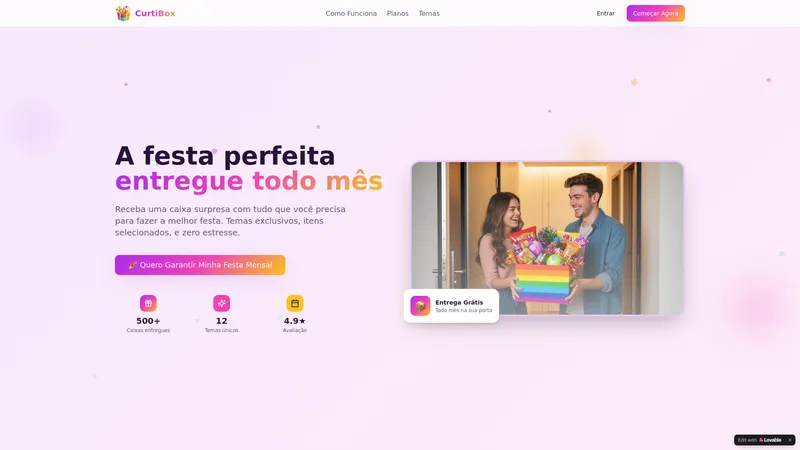
Project created in the live stream:
CurtiBox - Subscription Party
Duration
1h 30m of content
Methodology
Lean Startup + Canvas
Practical
Live examples
Once you've validated that there is a real problem and that people would pay for a solution, it's time to build your Minimum Viable Product (MVP). But beware: an MVP does not mean a bad or incomplete product.
A good MVP solves one specific problem satisfactorily. It doesn't need to have every imaginable feature — only the essential ones to validate your main hypothesis.
Avoid these mistakes, and you will already be ahead of 90% of entrepreneurs
Many entrepreneurs get attached to their original idea and resist changes. The market doesn't care about your specific solution — it wants to solve a problem. Be willing to pivot.
Most ideas are not as original as they seem. What sets successful businesses apart is execution, not the idea. Sharing early generates valuable feedback and potential partners.
50-page business plans don't validate anything. The market validates your idea, not a document. Every week you go without testing, you lose valuable learnings.
No successful business was built by a single person. Seek co-founders, mentors, accelerators. A support network multiplies your chances of success.
In the validation phase, understanding Customer Acquisition Cost (CAC) is a rule, as well as predicting how much they will pay and if the math works out. Unit economics are not just for large companies.

The inventor falls in love with their creation. The scientist formulates hypotheses and rigorously tests them. Modern entrepreneurship requires a scientific mindset.
Every feature is a hypothesis. Every marketing campaign is an experiment. Every customer conversation is data collection. When you adopt this mindset, "failure" ceases to exist — there is only learning.

Reid Hoffman, founder of LinkedIn, said: "If you are not embarrassed by the first version of your product, you've launched too late."
In the startup world, speed of learning is your greatest competitive advantage. Large companies are slow to change. You are not. Use that to your advantage.
Launch quickly. Collect feedback. Iterate. Repeat. This cycle, executed with discipline, is what separates successful businesses from ideas that die in a drawer.

The "build in public" movement has gained traction in recent years for a reason: it works. When you share your journey, you attract people who want to help.
Potential customers, investors, mentors, and co-founders appear when you are transparent about your challenges. Participating in an entrepreneurial community — like the one at Shinier Accelerator — dramatically accelerates your learning.
Ferramentas modernas permitem que não-programadores criem protótipos e MVPs. Mas será que substituem o desenvolvimento profissional?
Ex: Glide.app
Ideal para protótipos rápidos e apps simples baseados em planilhas. Zero programação necessária.
Custos Glide.app:
Ex: WordPress
Flexibilidade com plugins e temas, mas customizações avançadas exigem código PHP/CSS.
Custos envolvidos:
Ex: Lovable.dev
IA que gera código real a partir de prompts. Resultado profissional com velocidade impressionante.
Custos Lovable.dev:
Embora essas ferramentas sejam excelentes para validar ideias e criar protótipos, para lançar um produto profissional no mercado, quase sempre é necessário um programador ou especialista.
🔄 O problema do "remendo"
Trocar de desenvolvedor ou ficar "remendando" com diferentes freelancers acaba saindo 2-3x mais caro do que fazer certo desde o início.
🏗️ Erros de arquitetura
Quando o dono começa e depois contrata um dev para finalizar, os erros de arquitetura e decisões erradas do início geram retrabalho e encarecem a manutenção.
💡 A verdade contraintuitiva:
Pode parecer que não, mas nessas ferramentas quanto maior a senioridade do profissional, mais rápido e mais barato sai o projeto. Um sênior evita armadilhas, toma decisões corretas de arquitetura e entrega em menos tempo.
You've made it this far. This means you are serious about getting your idea off the ground. Now is the time to take action. Not tomorrow. Not next Monday. Today.
Create your Shinier account and register your startup. In less than 5 minutes, you will have access to all the ideation tools to structure your business.
Register Startup for FreeUse the ideation tools to fill out your Business Model Canvas. Shinier's AI will help you articulate each block clearly and professionally.
View ToolsIf you want to accelerate your journey even further, schedule a chat with our team. We understand your current stage and can suggest the best path to get your idea off the ground.
Talk to SalesMost people fail to turn ideas into reality for three reasons: lack of a structured method, fear of validating the idea in the real market, and trying to build something perfect from the start. A structured process with ideation tools solves these problems.
With a structured process and the right tools, it is possible to validate an idea and create an MVP in 30 to 90 days. The time varies depending on the complexity of the product and the entrepreneur's level of dedication.
Not necessarily. With modern no-code, low-code, and vibe-code tools, it's possible to validate ideas with a very low initial investment. The most important thing is to validate before investing large sums.
Ideation tools are methodologies and platforms that help entrepreneurs structure, validate, and develop their business ideas. They include the Business Model Canvas, SWOT analysis, Porter's 5 Forces, and platforms like the Shinier Accelerator.
Shinier offers a complete ecosystem for startups: ideation tools with AI support, proven methodologies, an entrepreneurial community, and an acceleration program. It is the ideal partner for those who want to go from an idea to the market in a structured way.
Thousands of entrepreneurs have already turned their ideas into real businesses using the tools and methodologies at Shinier. It's your turn.