

Scrum Software Development Stages: 2026 Definitive Guide for Startups and Partners
Increase your productivity and turn your software house into a startup factory. Discover the 2026 Scrum stages powered by Shinier.
In 2026, software development is not just about delivering code; it's about validating value in record time. The Scrum framework has evolved into what we call Agentic Agility, integrating AI into every decision.
For software houses and startups in the Shinier ecosystem, Scrum has become the engine of a radical transformation: moving from a scattered services model to scalable productization.
The Software House Dilemma: Why Productize in 2026?
Many traditional software houses still operate on a "selling hours" (body shop) model. In 2026, this model is unsustainable. Massive automation has reduced the value of "raw code", but exponentially increased the value of a niched problem solution.
The challenge is dispersion: serving 10 clients from 10 different sectors prevents the creation of assets. Scrum 2.0 helps identify patterns, systematize development, and create solutions that can be sold as products (Micro-SaaS).
The Leap to Startup
- 1. Identify the Pattern: Use Scrum to map common pain points among your clients.
- 2. Systematize Assets: Create reusable components in the Shinier Accelerator.
- 3. Niche Wins the Game: Turn a recurring service into a niche platform.
Your Software House can be a Startup Factory
Stop serving clients in a scattered way. Use our technology to productize your services and scale as a Shinier partner.
The Modern Scrum Development Journey
Strategic Discovery
Validating ROI and latent pain points using AI before writing a single line of code.
Agentic Backlog
Automatic refinement of epics into granular tasks with AI criteria.
Continuous Sprint
Accelerated development by Copilots with integrated agentic QA.
Value Review
Impact analysis on business OKRs and proof of real value delivered.
Phase 1: From Briefing to Strategic Discovery
The traditional briefing is dead. In 2026, we start every project with the Strategic Discovery. For our partner software houses, this is the stage where we turn the client's "wish list" into a scalable product strategy.
We use tools that cross-reference market data and user behavior to validate if what is being built solves a niche problem. If a feature doesn't move the business needle, it never even makes it to the backlog. This ensures the team never wastes energy on irrelevant features.

Phase 2: Agentic Backlog and Value Prioritization
The Product Backlog is no longer a static spreadsheet. Shinier's Agentic Backlog automatically breaks down large epics into User Stories rich in technical details and business requirements.
Automatic QA Onboarding
Each task is born with its test scripts generated by AI.
Prioritization by ROI
The system suggests the execution order based on the lowest cost and highest impact.
High Performance Metrics (DORA)
Teams using Shinier's Scrum 2.0 reach elite indices in the global technology market.
Continuous delivery to production.
From commit to end user.
Extreme code quality.
Automatic agentic resilience.
Phase 3: Accelerated Execution and Continuous QA
During the sprint, development is supercharged by Execution Agents. The engineering team wastes no time with boilerplate; the focus is on architecture and the business solution.
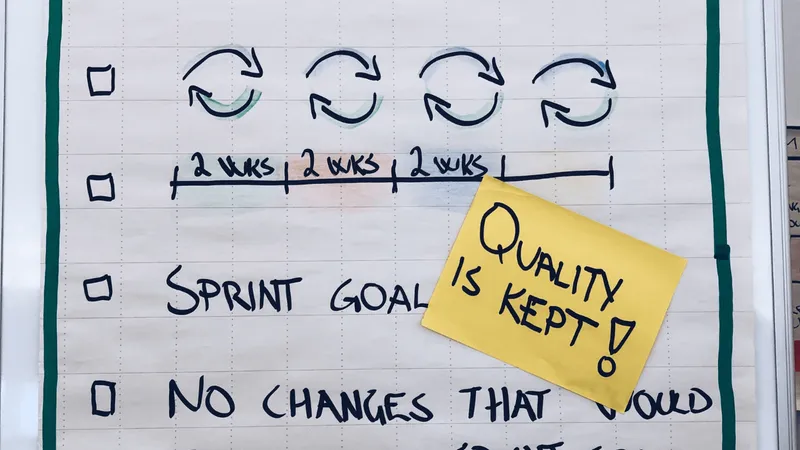
QA (Quality Assurance) happens on every line of code written. If a change breaks a critical flow, the AI blocks the commit and suggests a fix instantly, drastically raising the project's security.
Phase 4: Value Review and Proof of Value
The old 'Sprint Review' has evolved. In 2026, we don't just show finished features; we perform a Proof of Value. We analyze how the sprint's increment directly affected the client's business metrics.
For partner software houses, this is the moment to demonstrate to the client that development is aligned with ROI (Return on Investment). This is where real user feedback, collected during the sprint, is turned into new insights for the next Strategic Discovery.
Value Delivery Metrics
Impact on Users85%
Vision Compliance92%
The Science of Productization: Turning Projects into Assets
The great secret of successful startups born from Shinier partnerships is Asset Systematization. By running Scrum for a specific niche, the partner starts accumulating ready-made modules.
The Asset Roadmap
• Sprint 1-4: Core System Development (Start of productization).
• Sprint 5-8: Creation of Plug-ins for the niched vertical.
• Sprint 12+: The product takes on a life of its own, and the Software House owns a Micro-SaaS.
This way, the partner goes from being just a software executor to a co-founder of scalable technological solutions, using Scrum as the framework for governance and scaling.
Glossary: The Language of Agentic Agility
Process where AI assists the PO in writing and breaking down complex tasks.
Set of 4 metrics (Lead Time, Deployment Frequency, etc.) that measure team performance.
Visual mapping of where value is generated and where there is waste in the process.
Pre-sprint validation phase that crosses business data with technical feasibility.
Referências
- SOMMERVILLE, Ian. Software Engineering. 10th ed. Pearson, 2019. Agile fundamentals. Pearson
- FORSGREN, Nicole. Accelerate: The Science of Lean Software and DevOps. The bible of DORA metrics. IT Revolution
- ADIZES, Ichak. Corporate Lifecycles. Essential for understanding the leap to a startup. Adizes Institute
From Software House to Startup: Ready to Productize?
Become a partner in the Shinier ecosystem and use our tools to transform your agency into a factory of scalable digital assets.
I want to become a Partner