

Strategic Execution in Startups: Turning Goals into Deliverables with OKRs
Most startups don't fail for lack of strategy: they fail because strategy never reaches the team's weekly calendar. This guide reveals how to transform objectives into key results and deliverables, separate OKR from KPI, roadmap, and backlog, prioritize under constant urgency, sustain accountability rituals, and operate a predictable monthly execution cadence.
There is a recurrent pathology in almost every startup that outgrows its initial cohort of customers: the annual business plan is compelling, the team is talented, the market responds — yet the quarter concludes with half the strategic bets incomplete. Upon closer inspection, the failure is almost never the strategy itself. It is the absence of a translation mechanism connecting high-level strategy to weekly choices. Strategic execution is that operating system: the framework of translations, trade-offs, and rituals that converts intent into verifiable deliverables.
Execution does not mean clocking longer hours. Teams that struggle with execution are usually burnt out, not idle. What is missing is discipline and rhythm: few bets per cycle, each with a single owner and numeric metric, inspected frequently enough that drift surfaces while correction remains feasible. A strategy audited only once per quarter discovers its deviation when the quarter is already lost.
This playbook maps the entire architecture: why sound strategies fail, how to craft objectives and key results that resist becoming task checklists, the distinct roles of management tools, how to prioritize under pressure, which rituals maintain accountability, how to navigate dependencies, risks, and scope creep — and concludes with a plug-and-play monthly execution blueprint.
💡 The fatal pitfall of founders: conflating initiative volume with ambition. Five parallel strategic bets across a ten-person squad is not ambition — it is a mathematical guarantee that none will receive the dedicated focus required to prove viability.
Why Do Great Strategies Fail in Execution?
The primary culprit is absence of translation. Strategy is authored in positioning vocabulary — market segments, value propositions, competitive moats, revenue models —, whereas sprint work operates in the language of tasks. Between these two tiers must live an intermediary layer defining what measurably changes in customer behavior and company unit economics if that strategy is correct. Without that layer, each department interprets priorities arbitrarily, producing efforts that are coherent in isolation but fragmented in aggregate.
The second cause is dilution. Strategy is selection, and selection requires explicit trade-offs. When leadership accommodates every initiative to avoid internal friction, squads receive a laundry list rather than a directional mandate. Capacity is shaved into slices too thin to achieve escape velocity on any single front. This is Richard Rumelt's classic diagnostic of bad strategy: goals piled together in lieu of focused choice backed by honest diagnosis.
The third cause is lack of a management system. Strategy does not persist through collective memory alone: it requires a dedicated operating cadence, where operational firefighting is decoupled from strategic retrospectives, initiatives carry budgets and owners, and experimentation cycles are explicit. When this operating system is absent, short-term urgency cannibalizes 100% of calendar bandwidth — because urgent tickets always have deadlines, whereas strategy rarely does.
Without Diagnosis
The plan begins with targets, skipping the vital antecedent question: what specific bottleneck halts growth today? Without this diagnosis, teams battle surface symptoms while the root constraint persists quarter after quarter.
Without Focus
Too many parallel commitments relative to available capacity. The penalty is not merely schedule delay: it is chronic context switching, which bleeds ramp-up time and prevents any bet from reaching the threshold of statistical significance.
Without Ownership
A collective goal belongs to nobody. Until a key result carries an accountable individual name, it will be championed in meetings and abandoned the following week without anyone explaining the deviation publicly.
Without Cadence
Reviewing the strategic plan only at cycle-end reduces management to an autopsy. Review cadence dictates the radius of course correction: squads that review weekly miss by days; squads reviewing quarterly miss by months.
Does your startup boast great plans on slides but irregular delivery across quarters?
The chasm between vision and execution is rarely technical: it is methodological. Selecting few bets per cycle, authoring verifiable key results, prioritizing via transparent rubrics, and executing a rhythm that flags drift early is an operating muscle best built through guided implementation.
This is precisely what the Shinier Accelerator engineers: from OKR definition to product roadmaps, from financial burn modeling to execution rhythms, backed by a technical co-founder to convert decisions into production software.
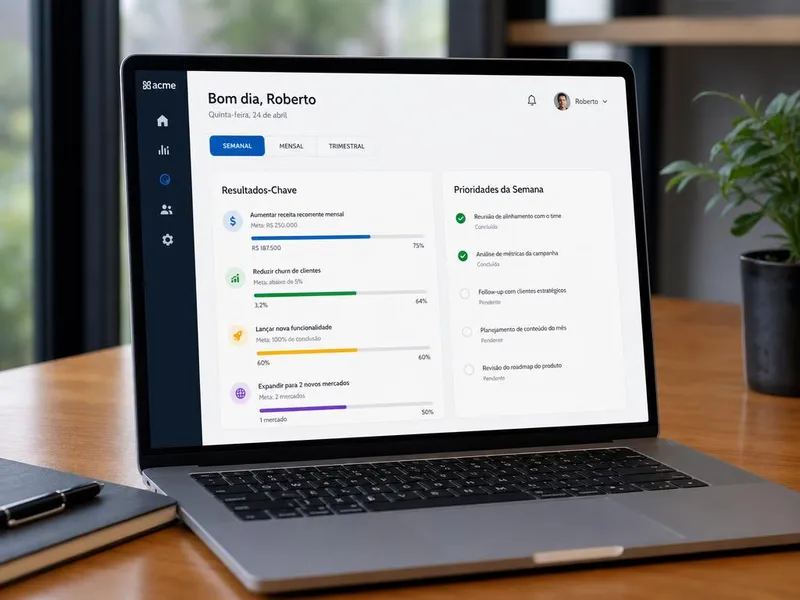
How to Translate Objectives into Key Results and Deliverables
The objective answers 'where are we steering in this cycle?' It is qualitative, concise, and immediately intelligible to any team member without supplementary documentation. A quick litmus test is reciting the objective out loud: if it sounds like a task ('deploy the redesigned checkout'), it is an initiative, not an objective. If it reads like generic promotional fluff ('dominate the enterprise market'), it fails because it neither establishes focus nor enforces trade-offs.
Key results answer 'how will we prove we arrived?' Formulate two to four per objective, fully numeric, specifying baseline values, targets, and cycle completion dates. The most frequent trap is writing them as completed effort — meetings booked, features shipped, ad campaigns activated — rather than observable customer behavior or venture unit economics. Shipping every roadmap feature while failing to budge a single key result is invaluable intelligence: it proves the underlying product hypothesis was incorrect, and learning that in week six is far cheaper than in month twelve.
Deliverables, or initiatives, occupy the third tier: the strategic bets hypothesized to move those metrics. They are working hypotheses, not sacred covenants. If after three weeks of steady delivery a key result exhibits zero momentum, the initiative must be pivoted, not the goal lowered. Separating what you strive to achieve from the initial tactic you chose to test is what protects teams from demoralization: you abandon an experiment, not the destination.
In day-to-day operations, standardizing this syntax proves invaluable: 'We will [objective], measured by [key result], betting on [initiative], owned by [accountable lead] by [date]'. When all five fields are populated seamlessly, the plan is execution-ready. When any slot demands elaborate rationalization, unresolved ambiguity remains.
What Is the Difference Between OKR, KPI, Roadmap, and Backlog?
These four frameworks coexist to solve distinct problems. Treating them as synonyms breeds classic execution anti-patterns: OKRs that become task lists, KPIs abused as aggressive sprint targets, roadmaps read as fixed contractual deadlines, and backlogs degraded into bottomless wishlists.
| Framework | Core Question Answered | Planning Horizon | Common Anti-Pattern |
|---|---|---|---|
| OKR | What strategic transformation do we want to provoke in this cycle and how will we prove it occurred | Quarterly, reviewed weekly | Degrading into a task checklist with dates, lacking numeric outcome metrics |
| KPI | Is the ongoing operational health of the enterprise within acceptable tolerance bands | Continuous, constantly monitored | Promoted to an aggressive quarterly target, distorting engineering behavior |
| Roadmap | In what sequence and over what horizons do we plan to tackle strategic bets | Quarterly horizons, with decaying precision | Communicated as firm delivery promises to enterprise clients and investors |
| Backlog | What is the very next work item ready to be engineered and delivered | Weekly, ordered strictly by priority | Accumulating every unsolicited feature idea, becoming a stagnant archive |
| Portfolio | How do we allocate total engineering capacity across maintenance, optimization, and new bets | Annual, recalibrated quarterly | Ignored formally, allowing urgent bugfixes to consume all strategic capacity |
A straightforward heuristic preserves clarity: OKRs change every cycle, KPIs endure; roadmaps communicate directional intent, backlogs organize sprint execution; portfolio governance dictates how much total capacity is available for new bets. When someone proposes a goal, first ask which container it belongs to — this resolves half of all unproductive planning debates.
How to Prioritize When Everything Feels Urgent
Perceived urgency is almost always the symptom of an overloaded intake queue. When work-in-progress exceeds team capacity, every item slips behind schedule, and every delayed ticket escalates into an emergency. The primary cure is not sophisticated ranking: it is throttling open work until the queue clears. A squad completing three items per week with relentless focus delivers far more throughput than one juggling fifteen partially started tickets.
The second requirement is a transparent, objective prioritization rubric. Whether you choose RICE, WSJF, or cost of delay, the vital factor is that the formula is documented and uniformly applied — including to requests originating from the founder. An explicit rubric shifts debates from 'who commands the loudest voice?' to 'what leaves the queue to accommodate this addition?'
Impact and Confidence
Evaluate how substantially the work moves the cycle's key results alongside the rigor of empirical evidence supporting the assumption. High-impact bets with low confidence must begin as cheap discovery prototypes, not full-scale software builds — validating early costs vastly less than polishing what nobody wants.
Cost of Delay
Quantify what is lost per week of postponement: missed ARR, customer churn, compliance fines, or compounded rework. High cost-of-delay items requiring modest engineering lift take immediate precedence — this dynamic, not arrival order, must govern the queue.
Work-in-Progress (WIP) Limits
Enforce explicit caps on concurrently open tickets per engineer and across squads. This is the single highest-leverage lever to expand throughput: it mandates finishing before starting and surfaces the true constraint within days.
Which Weekly Rituals Sustain Focus and Accountability?
Accountability is not extracted through individual micromanagement: it emerges when operational progress is made transparent enough that policing becomes redundant. An effective suite of rituals is tight, timeboxed, and concludes with recorded decisions. The goal is never bureaucratic reporting; it is surfacing variance and committing to remediations while the week can still be salvaged.
- Monday, 30 minutes: review key results with current metrics, velocity trends, and explicit forecasts declared by individual owners.
- Daily, 15 minutes: laser-focused on blockers and cross-squad dependencies — who is blocked, on what, and since when.
- Wednesday, 45 minutes: deep dive on a single critical cycle bottleneck, concluding with actionable decisions and designated owners.
- Friday, 30 minutes: verify production releases, clear finished items, and reprioritize the upcoming week against published criteria.
- Bi-weekly, 60 minutes: concise process retrospective focused on workflow efficiency rather than personalities, agreeing on maximum two adjustments.
- Universal rule: any meeting concluding without recorded decisions or named owners is a prime candidate for immediate calendar deletion.
Two details ensure these rituals succeed. First, owners must declare forward-looking forecasts, not merely historical percentages: asserting 'we expect to reach 70% of target by Friday' establishes a verifiable commitment for next week. Second, separate operational reviews from strategic syncs — blending them guarantees daily firefighting consumes the quarterly bet every time.
How to Manage Dependencies, Risks, and Scope Creep
Dependencies represent the silent execution killer in startups. They rarely appear in initial estimates because they depend on third parties — an external vendor, a client approval, a partner squad, or an API gateway. The mitigation is universal: identify dependencies at cycle planning, assign an internal owner, set a drop-dead viability date, and formulate a contingency branch before that date arrives.
Risk requires analogous discipline, but managed through tripwires rather than passive logs. Writing 'risk of integration delay' accomplishes nothing. Establishing 'if sandbox credentials are not approved by the 15th, we launch with a semi-automated workflow and defer full integration to next sprint' transforms anxiety into a pre-agreed operational contingency.
Scope adjustment, ultimately, is not a failure — it is proof that the venture is learning from market feedback. What must be ruthlessly prevented is silent scope creep: additions accepted without removals. Every adjustment must answer three questions: what fresh customer evidence justifies this change, which key result does it advance, and what leaves the sprint queue to free bandwidth? Unbounded scope is not agility: it is organizational indecision outsourced to exhausted engineers.
| Scenario | Warning Indicator | Recommended Operational Protocol |
|---|---|---|
| External Third-Party Dependency | Ticket idle over a week waiting on partner feedback | Name internal owner, establish drop-dead SLA, and architect contingency path in advance |
| Cross-Squad Engineering Friction | Two squads operating with divergent sprint priorities for one deliverable | Align at the shared key result level and sequence workflows sequentially rather than in parallel |
| Significant Technical Risk | High uncertainty regarding architecture feasibility or query latency | Slice into a rapid, inexpensive proof-of-concept before committing an entire development cycle |
| Unplanned Enterprise Feature Request | Sales commitments made outside the strategic prioritization cadence | Enter the backlog through standard rubric evaluation, explicitly identifying what project is bumped |
| Key Result Lacking Momentum | Three weeks of steady code delivery with zero metric progression | Pivot the tactical initiative while preserving the target, documenting the discarded hypothesis |
Monthly Strategic Execution Cadence Blueprint
The blueprint below is immediately deployable by teams of five to thirty contributors. It assumes quarterly OKR cycles, weekly key result health checks, and a monthly executive sync examining sprint progress, portfolio allocation, and capital runway. Crucially, each week carries a unique thematic focus — preventing the four monthly meetings from degrading into the same status update repeated four times.
Week 1 — Direction & Alignment
- Audit key results with live metrics, trajectory velocity, and end-of-month forecasts.
- Affirm the top three strategic bets for the month and explicitly document what remains deprioritized.
- Lock in external dependencies with contractual drop-dead dates and fallback routes.
- Publish the month's intake queue on an executive dashboard accessible across the venture.
Week 2 — Deep-Dive Resolution
- Deconstruct one critical cycle bottleneck with empirical telemetry and recorded executive decisions.
- Review ongoing customer discovery experiments and sunset those that reached statistical clarity.
- Inspect work-in-progress limits and eliminate constraints throttling delivery velocity.
- Calibrate squad capacity models based on actual yield observed in week one.
Week 3 — Course Correction
- Benchmark week one forecasts against actual mid-cycle achievement.
- Pivot initiatives demonstrating zero movement on target key results, preserving the goal.
- Trigger predefined risk contingencies whose operational deadlines have been breached.
- Anticipate contractual deliverables requiring client or vendor alignment.
Week 4 — Month-End Retrospective
- Synthesize monthly deliverables, documenting shipped software alongside validated customer learnings.
- Review engineering portfolio allocation: capacity split across maintenance, refinement, and strategic innovation.
- Reconcile sprint velocity against monthly cash burn, gross margin, and capital runway.
- Establish next month's strategic priorities and publish a one-page executive memo.
At quarter close, schedule an expanded strategic retrospective: audit key result achievement rates, synthesize customer learnings, and determine whether the core hypothesis that spawned the roadmap remains valid. This meeting prevents the single worst failure mode of a well-oiled execution engine — flawlessly executing the wrong strategy for an entire year.
Execution Is an Operating System, Not an Ad-Hoc Sprint
The most pervasive misconception about execution is treating it as brute intensity: attributing missed goals to insufficient effort. That is almost never true. Failures stem from lack of selection (taking on too many bets), lack of translation (failing to link features to metrics), and lack of cadence (reviewing too infrequently to steer). Squads implementing these three disciplines work fewer overtime hours while delivering higher throughput, because they cease wasting capacity on projects destined to stall.
The roadmap to elite execution is repeatable and unglamorous: isolate the real constraint, commit to at most three objectives per cycle, validate each with two or three honest outcome metrics, assign individual ownership, enforce work-in-progress limits, audit health weekly, and close the month reconciling burn rate against delivered software. Execution is the compound interest of modest, disciplined choices made in predictable rhythm week after week, until strategy ceases to be a slide deck and becomes the everyday heartbeat of the business.
Referências
- DOERR, John. Measure What Matters. Essential text codifying the OKR architecture originating at Intel: qualitative, audacious objectives backed by numeric, verifiable key results. Imposes the crucial operational discipline of separating aspirations from evidence and reviewing cadences within the active cycle. Explore What Matters OKR Guide
- KAPLAN, Robert S.; NORTON, David P. The Execution Premium. Describes the formal bridge connecting strategy to daily operations: balanced strategy maps, funded initiatives, separate operational and strategic cadences, and explicit feedback loops preventing annual plans from gathering dust. Explore Balanced Scorecard Framework
- BOSSIDY, Larry; CHARAN, Ram. Execution: The Discipline of Getting Things Done. Defines execution as a core leadership discipline. Argues that sustainable performance requires linking people, strategy, and operations, and that most strategic failures stem from unassigned goals and lack of real accountability.
- RUMELT, Richard. Good Strategy/Bad Strategy. Protects teams from executing flawed strategy. Demonstrates that authentic strategy comprises diagnosis, guiding policy, and coherent action, whereas bad strategy is an unprioritized wish list devoid of trade-offs. Explore Strategy& Insights
- ATLASSIAN. Team Playbook. Translates execution principles into operational team rituals: structured meeting templates, role definitions, team health monitors, and retrospectives that turn strategic intent into effective collaboration. Explore Atlassian Team Playbook
Pronto para começar?
Use as ferramentas do Shinier Accelerator para criar seu projeto de forma estruturada.
Começar Agora