

Organic Community Growth: How to Turn Customers into Networks and Referrals
Organicity is not algorithmic luck: it is a growth strategy planned on day zero to turn customers into a network. Discover the difference between audience, community, and network, key rituals, roles across each phase, and the realistic 3 to 5-year plan.
Every startup eventually arrives at an uncomfortable reality: customer acquisition costs rise, sales cycles do not shorten, and each dollar spent on ads buys less attention than it did the previous quarter. This is the moment when the term organic growth emerges — almost always misunderstood as a cheap content tactic. Organicity is not a channel: it is the capacity to grow because existing product users bring in new people and stay longer.
The difference becomes evident when observing what remains after six months. A functioning paid campaign leaves behind customers and ongoing spend. A viral post leaves a spike in visits and no lasting relationship. But an active community leaves something remarkably durable: people answering other people's questions, writing unprompted tutorials, defending the product in rooms where your brand is absent, and bringing colleagues without formal incentives.
There is an almost universal pattern here: most startups only think about community after ad costs and CAC have skyrocketed. At that stage, community is treated as a rescue plan — and fails, because communities cannot be assembled overnight. It is indeed a growth strategy, but one that must be planned on day zero of the startup, well before MVP launch, rather than the quarter when paid media ceases to break even.
This article outlines the architecture behind it. Community management research demonstrates a consistent finding: mature communities are not necessarily the largest; they are those with defined purpose, clear roles, cadence, and recognition systems. Without these four pillars, you only have a broadcast chat where the company talks to itself. With them, the realistic horizon is three to five years across three distinct phases: an early adopter community pre-launch, an engaged community during validation and traction, and a customer-led thriving community at scale.
💡 The biggest founder mistake: launching a group once CAC is already expensive and labeling it a community. A community only exists when members talk to one another and derive tangible value from that exchange — which takes years, not quarters. If the company is the only node in the network, you built an announcement channel, and broadcast channels generate silence, not referrals.
What is organic growth and how does it differ from free reach?
Free reach is a distribution metric: how many people saw an asset without you paying per impression. It is inherently volatile because it depends on third-party platforms whose algorithms change without warning and whose economic incentive is precisely to curtail unpaid reach. Organic growth is a systemic metric: what proportion of customer inflow is driven by current users, and what fraction of the base stays voluntarily.
The practical consequence is financial. Free reach must be re-earned with every new post, mirroring the dynamics of paid media without its predictability. Organicity compounds: each contributing member increases the perceived value for existing users, dampening churn, which in turn expands the pool capable of referring others. It is a reinforcing loop — slow initially, virtually impossible to copy later.
| Dimension | Free reach | Organic growth |
|---|---|---|
| Unit of value | Impressions and clicks on a single piece of content | Ongoing relationship with users who return and bring peers |
| Source of outcome | Distribution dictated by third-party platform algorithms | Perceived utility among members and accumulated trust |
| Behavior over time | Isolated spikes that rapidly decay post-publication | Compounding curve: today's active base expands tomorrow's inflow |
| Primary vulnerability | Algorithm adjustments wipe out channel traffic overnight | Loss of clear purpose and cadence drains member engagement |
| Measurement | Reach, impressions, followers, views | Activation, contribution rate, cohort retention, referral volume |
| Impact on CAC | Temporarily lowers media cost while the spike lasts | Structurally lowers CAC as inbound demand is no longer bought |
This does not mean abandoning paid media. It means understanding the role of each: paid media buys velocity and hypothesis testing; organicity buys margin and retention. Startups that grow sustainably use the former to find the right customer and the latter to turn that customer into a distributor.
Looking to build a referring customer base rather than a leaky funnel?
Community does not substitute product: it amplifies a product that genuinely solves a critical problem for a defined audience. That is why the foundation starts before groups, events, or referral programs — with a clear persona, sharp value proposition, and delivery cycles that produce enough impact for someone to want to recommend you.
This is precisely what Shinier Acceleration structures: persona validation, purchase intent testing, pricing, roadmaps, and the metrics to measure activation, contribution, and referrals without vanity illusions.

How belonging transforms customers into active participants?
Belonging is the conviction that a space belongs to you as well — that your perspective shapes outcomes, that you are surrounded by peers, and that leaving carries a social cost. It is an emotional reality underpinned by concrete mechanisms: shared identity, visible recognition, common history, and the genuine ability to influence decisions.
Tribal literature clearly delineates the leader's role: provide an environment and a cause, not rigid control. When a brand dominates every speaking slot, it unintentionally sends the signal that everyone else is merely an audience. Thriving communities do the exact opposite — they intentionally leave vacuums for members to lead tracks, moderate channels, present case studies, and refine documentation. Every gap filled by a member is a step up the ladder of belonging.
The most decisive trigger is the very first act of contribution. A passive consumer remains anonymous even to themselves; a member who answered a question, shared a template, or presented a result gains reputation within that community. This is why the first week matters far more than invite campaigns: if newcomers are not welcomed by name, prompted with specific questions, and publicly thanked for their first answer, silence takes root and becomes exceedingly costly to overturn.
An uncomfortable truth: belonging cannot be purchased with merchandise. Discounts attract deal-seekers, and deal-seekers do not refer — they negotiate. What sparks true engagement is utility combined with status: learning insights unobtainable elsewhere and receiving recognition from respected peers.
What is the difference between audience, community, and network?
Conflating these three phases is the root cause of unmet expectations. They demand different resources, yield returns over distinct timelines, and fail for entirely different reasons. While often evolutionary, progression is never automatic: large audiences rarely evolve into communities, and healthy communities seldom become self-sustaining networks — which is completely acceptable if it aligns with strategy.
Audience
One-to-many relationship. People follow the brand, consume content, and occasionally buy, but have no connection to one another. Scales quickly and incurs low startup costs; the limitation is that value relies solely on company output. If publishing stops, engagement cools in weeks.
Community
Many-to-many relationship anchored in shared identity and goals. Members recognize one another, provide mutual support, and establish group norms. Grows gradually, requiring curation, moderation, and rhythm; in return, it drives retention, product insights, and organic referrals.
Network
An ecosystem where member-to-member interactions generate proprietary value: peers hiring, selling, exchanging data, or partnering directly. It represents the highest defensibility, as switching costs encompass forfeiting network access — not just software features.
The network effects framework serves as an honesty filter. Network effects exist when each incremental participant enhances product value for all prior users — something not every community achieves. A busy support forum improves user experience but does not inherently create defensive moats; a marketplace where every new supplier enriches options for all buyers does. Knowing which model applies keeps you from promising defensibility your architecture lacks.
How referrals, advocacy, and user content drive down CAC?
The referral mechanics articulated in the promoter framework are straightforward: referrers have already executed the persuasion work your sales team would otherwise shoulder. The lead arrives with objections resolved, expectations calibrated by a trusted colleague, and the use case already contextualized. The impact surfaces across three funnel stages simultaneously: higher conversion, compressed sales velocity, and lower early churn.
Advocacy represents the subsequent tier: customers championing your product in third-party spaces — professional roundtables, tool evaluations, and internal vendor reviews. User-generated content introduces an asset compounding effect: a detailed tutorial, review, or customer case published by a member continues driving inbound demand for months without incremental marketing spend, bearing a credibility institutional collateral cannot rival.
Referrals
Replaces ad expenditure with pre-existing trust. Most effective when asks are specific and frictionless: recommending one specific peer in a well-defined context with an onboarding pathway ready — rather than generic 'share with anyone' prompts.
Advocacy
Spontaneous defense in third-party spaces, especially critical in B2B purchasing where peer consensus outweighs sales presentations. Stems from verified operational outcomes and consistent recognition, not shallow brand ambassador gimmicks.
User content
Tutorials, templates, comparisons, and forum resolutions create searchable organic assets and decrease customer support workload. Member-authored content simultaneously powers acquisition and retention by accelerating time-to-value for new cohorts.
CAC impact
The genuine economic gain is not 'free leads' but structural dilution. When a percentage of customer inflow originates organically, blended CAC declines even with sustained ad spend, freeing capital to reinvest into core product capabilities.
A vital caution: referral incentives tied to heavy financial rewards before achieving genuine product satisfaction yield disastrous results — flooding pipelines with unqualified leads and eroding referrer trust. The disciplined sequence is to measure willingness to recommend, address detractor root causes, and only then streamline the referral journey for those already eager to advocate.
Which rituals and roles sustain a healthy community?
Community maturity research converges on an unglamorous principle: sustained engagement is a function of cadence and designated roles, not bursts of inspiration. Enduring communities adhere to predictable schedules and assign dedicated leaders to welcome, moderate, curate knowledge, and represent community feedback within product teams.
Rituals that build predictability
- Weekly personal welcome: introducing new members with an engaging prompt designed to elicit their first response. This ritual yields the highest impact on early activation.
- Monthly live spotlight: a one-hour session highlighting an operational case study presented by a member, not the startup team. Generates content, social proof, and referral momentum.
- Public Q&A cycles: designated days where queries are resolved publicly, converting support inquiries into searchable knowledge repository assets.
- Quarterly retrospective: showcasing tangible product updates implemented as a direct result of community suggestions. Validates that participation directly shapes roadmap outcomes.
Roles that require explicit ownership
- Host: welcomes newcomers, pairs members with overlapping challenges, and ensures no discussion thread sits unanswered beyond 24 hours.
- Moderator: enforces community norms consistently without confrontation. Unmoderated forums are hijacked by noisy participants, driving thoughtful contributors away.
- Curador: distills high-signal community dialogues into permanent documentation, actionable templates, and public insights — converting conversation into growth collateral.
- Product bridge: translates recurring friction points directly into roadmap prioritization and closes feedback loops. Without this, members feel ignored and cease participating.
- Member leads: experienced members managing specific topic tracks, regional chapters, or special interest channels. Delegating leadership enables scale without ballooning overhead.
These roles cannot be launched concurrently; attempting to staff all five from day one burns out teams without fostering grassroots participation. Pre-launch, the founder acts as sole host. During validation and traction, only two formal roles emerge: moderator and product bridge — sufficient to maintain psychological safety and ensure customer input influences product direction. Hosts, curations, and member leads only become necessary once discussion density scales. Crucially, member leads must be real customers receiving clear advantages, never junior marketing interns.
Two operational rules complete this section. First: codify community guidelines before conflict arises, clearly prohibiting disguised self-promotion, aggressive private outreach, and disrespectful discourse. Second: safeguard the community from your internal sales team. Nothing hollows out user trust faster than discovering a community is being mined as a prospecting list.
How to measure activation, contribution, retention, and network effects?
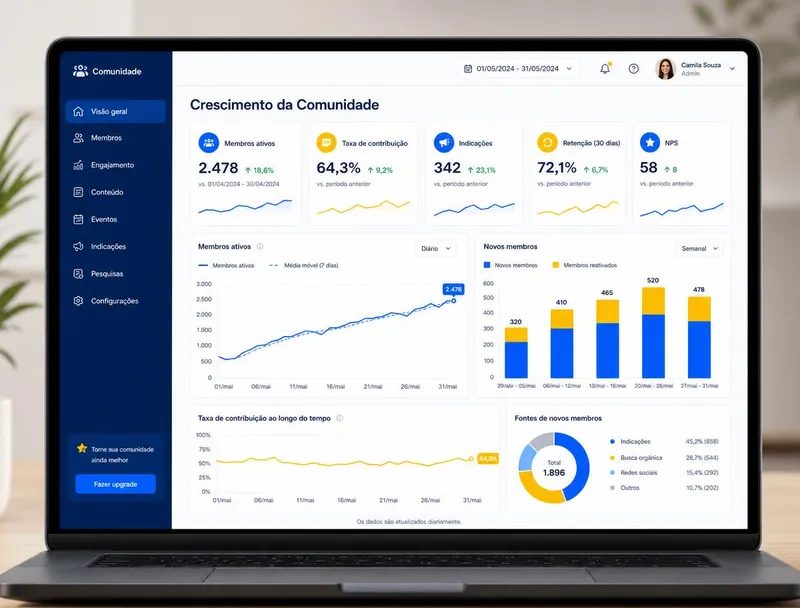
Total member count is the easiest metric to inflate and the least informative: you can double member size in a week while simultaneously destroying community cohesion. A meaningful analytics dashboard encompasses four layers, each addressing a distinct dimension of organic sustainability.
- Activation: percentage of new members making a meaningful first contribution within 14 days — commenting, answering, sharing an asset, or attending an event. If below double digits, onboarding is failing.
- Contribution: proportion of members actively creating value during the period and the concentration of that output. Communities where five contributors generate 90% of content are fragile.
- Cohort retention: percentage of users remaining active at 30, 60, and 90-day intervals post-entry. Reveals whether underlying utility is enduring or temporary novelty.
- Network effects: autonomous interactions between members, referral generation originating from community channels, and influenced pipeline revenue.
Supplement these with cohort-segmented Net Promoter Scores and a strict operational distinction between organic versus compensated referrals. This distinction prevents leadership from confusing purchased traction with genuine product advocacy.
The 3 to 5-year roadmap: from minimum viable community to thriving ecosystem
A minimum viable community is the leanest architecture capable of facilitating valuable peer-to-peer discussions without demanding daily founder intervention. It does not require custom software, native apps, or lavish event budgets — it demands narrow scoping, unambiguous purpose, and uncompromising consistency. What it truly requires is time: community is not a 90-day campaign; it is a foundational growth pillar conceived on day zero and nurtured over three to five years.
Accordingly, the roadmap below encompasses three structurally distinct phases — pre-launch, validation and traction, and scale. Each phase features its own milestone goals, operational roles, and definition of success. Attempting to execute phase three playbook with phase one maturity is why founders prematurely dismiss community-led growth as ineffective.
Phase 1 — Pre-launch (6 to 12 months before MVP)
Early adopter community: trusted friends, prospective initial customers, and advisors willing to brainstorm, test rough prototypes, and give candid feedback on a product in development. Consists of 20 to 40 individuals personally recruited, unified by a single-sentence mission statement. The founder must host personally without delegation. Success is immediate response latency when unveiling product wireframes and enthusiastic launch presence from co-creators.
Phase 2 — Validation and traction (1 to 2 years post-launch)
With the product live, every customer is integrated into the community as a standard step of onboarding. Two formal roles are instituted: the moderator, keeping discussions constructive, and the product bridge, ensuring customer feedback directly influences product backlogs. Fixed cadences are locked in: weekly welcomes, monthly spotlights, designated Q&A days, and quarterly retrospectives. Success is stable contribution rates and first organic referrals.
Phase 3 — Scale (1.5 to 2.5 years of compound growth)
Only once verified traction exists do scaling roles activate: dedicated hosts, content curators, and member leaders. Member leaders must be genuine power users receiving tangible perks: early feature access, community recognition, favorable terms, or roadmap steering advisory. In this phase, the ecosystem becomes truly decentralized: peer connections produce continuous value independently of company presence, transforming growth from paid campaigns into compounding infrastructure.
| Phase | Accelerated scenario (~3 years) | Sustainable scenario (~5 years) | Active roles |
|---|---|---|---|
| Pre-launch | 6 months before MVP | Up to 12 months before MVP | Founder acting as informal host |
| Validation & traction | 1 year | Up to 2 years | Moderator and product feedback bridge |
| Scale | 1.5 years | Up to 2.5 years | Host, curator, and customer chapter leads |
Three years represents an accelerated trajectory, feasible when founders possess an established professional network and an acute niche focus. Five years is the standard, sustainable timeline, as rigorous product validation and hyper-scaling rightfully take several years. Neither scenario begins post-launch: it starts on day zero with founder-led discussions with prospective users about a product that does not yet exist.
The initial 90 days remain crucial — not as the entire playbook, but as the initial checkpoint of Phase 1. If active dialogue and prototype feedback emerge within this window, press forward. If the startup remains the sole participant generating discussion, the friction stems from positioning or weak product value proposition, which no community tool can remedy.
Organicity is an outcome, not an advertising campaign
Whenever an organization attempts to artificially accelerate community engagement through promotional incentives, it discovers the same reality: incentivized participation vanishes the moment rewards expire. What endures is the alignment of a product that drives measurable outcomes, a collaborative space where members earn peer prestige by helping others, and reliable operational cadence.
The trajectory is methodical and verifiable: razor-sharp focus, transparent purpose, phase-appropriate responsibilities, predictable rituals, curation of member wisdom, and analytics focused on activation, contribution, cohort retention, and network velocity over empty follower counts. Executed systematically — starting on day zero with a multi-year mindset — organic growth ceases to be wishful thinking and becomes what it was meant to be: an engine turning satisfied customers into an active network, and network into compounding referrals.
Referências
- THE COMMUNITY ROUNDTABLE. State of Community Management. Serves as a foundational reference by tracking factors that distinguish value-generating communities: strategic maturity, structured roles, programmatic cadence, and decentralized member contribution. A key finding for founders is that mature communities feature significantly higher active contribution ratios as a direct result of design, rather than serendipity. Explore research from The Community Roundtable
- NFX. The Network Effects Manual. Categorizes network effect archetypes, demonstrating that not all viral referral growth creates true defensibility. Direct, marketplace, data, and social networks exhibit distinct mechanics, and identifying your product's actual dynamics prevents relying on false assumptions about competitive moats. Read the NFX Network Effects Manual
- REICHHELD, Frederick. The Ultimate Question 2.0. Connects willingness to recommend with compounding unit economics: promoters exhibit higher lifetime value, greater retention, and attract lookalike peers, whereas detractors erode equity even when scoring neutral. Establishes the framework for managing referrals as an operational discipline rather than an ad hoc marketing stunt. Learn more about the Net Promoter System
- CMX. Community Industry Report. Documents industry benchmarks across community frameworks by objective (support, product, acquisition, learning), team structures, budget allocation, and practical KPIs. Calibrates founder timeline expectations, highlighting that community maturity rarely manifests in under 12 to 18 months of disciplined execution. Access the CMX Community Industry Report
- GODIN, Seth. Tribes. Deconstructs the human dynamics governing collective engagement: individuals unite around shared conviction and belonging, where effective leadership provides environment and purpose rather than top-down control. Acts as the quintessential antidote against treating communities as free advertising billboards.