

Mental Health in Startups: How to Prevent Burnout for Founders and Tech Teams
Pulling all-nighters and working 80-hour weeks are not badges of honor in startups: they represent severe failures in process architecture and management. This comprehensive guide explores how to diagnose exhaustion in founders and developers, build psychological safety without medicalizing operational flaws, and implement an ethical sanity framework. Uncover subtle burnout warning signals, understand why vanity pressure erodes unit margins, and adopt vital tools to safeguard your most valuable scaling asset: your team's cognitive bandwidth and health.
Glamorizing hyper-exhaustion within startup culture created a toxic misconception: that rapid innovation mandates sacrificing the sanity of those building it. For years, founders sleeping under desks and engineers answering Slack messages at 3 AM were praised as emblems of dedication. The real aftermath of that ethos is undeniable: catastrophic turnover, compounding technical debt, erratic strategic decisions, and personal collapses that stall entire companies.
The World Health Organization (WHO) formally codified burnout in the International Classification of Diseases (ICD-11) not as an individual medical pathology, but strictly as an occupational phenomenon resulting from chronic workplace stress that has not been successfully managed. Burnout is not individual psychological weakness; it is a direct indicator of broken operational processes and misaligned leadership.
At Shinier, Sanity (Blue) serves as a non-negotiable acceleration pillar. We learned firsthand that resilient software architectures can only be created by emotionally whole individuals. An exhausted engineering squad might sprint through an emergency milestone, but the architectural debt accrued inflates maintenance expenditures for quarters to come.
In this practical playbook, we break down why technology environments are uniquely susceptible to exhaustion, outline the Maslach burnout triad, distinguish healthy deadline pressure from chronic overload, and furnish concrete frameworks to embed durable psychological well-being.
💡 The Shinier Sanity Principle: Work when you are well. Genuine engineering velocity is neither physical presence nor logged hours; it is mental clarity and cadence. We prefer developers to pause, recharge, and return whole rather than pushing a week of compromised code into production.
Ready to scale high-performance engineering squads without burnout?
At Shinier, Sanity (Blue) is a foundational pillar of startup acceleration. We guide founders and CTOs in structuring sustainable delivery cadence, psychological safety, and high-velocity engineering cultures free from exhaustion.
Why are founders and tech teams at heightened risk of burnout?
Tech startups combine distinct structural pressures that amplify cognitive fatigue. Diagnosing these variables is the prerequisite to stop faulting individual resilience and start engineering sound organizational systems.
The Founder's Burden
Founders bear the acute loneliness of making critical decisions under existential uncertainty. Enmeshing personal identity with corporate survival causes every investor rejection, customer churn, or product delay to feel like a personal life threat.
Compounding growth mandates alongside direct payroll responsibility lead founders to chronically sacrifice sleep, nutrition, and personal relationships across multi-year stretches.
Developers' Cognitive Load
Software engineers and product designers rely on uninterrupted deep work states, yet find themselves constantly fragmented by meetings, Slack pings, production bugs, and arbitrary mid-sprint pivots.
Writing reliable code requires sustaining complex, abstract mental models in active working memory. Every context switch shatters focus and extracts heavy cognitive energy just to re-orient.
Recognizing early signals of exhaustion, cynicism, and declining efficacy
As formulated by Christina Maslach and Michael P. Leiter in The Truth About Burnout, occupational exhaustion does not strike overnight. It emerges progressively through a distinct behavioral triad.
1. Emotional Exhaustion
Total depletion of physical and mental energy. Waking up exhausted after full sleep and dreading opening the laptop.
- Chronic insomnia and irritability
- Tension headaches and musculoskeletal pain
- Inability to decompress over weekends
2. Cynicism & Depersonalization
A psychological defense mechanism where team members detach emotionally, displaying chronic sarcasm, aloofness, and negativity toward peers.
- Defensive sarcasm in standups
- Disdain for business objectives
- Withdrawal from collaborative rituals
3. Reduced Professional Efficacy
Persistent feelings of incompetence and frustration with delivery speed. Routine tasks that previously took minutes stretch into hours.
- Paralyzing procrastination
- Sharp spike in trivial code regressions
- Chronic sensation of being stuck on implementation
According to Gallup's global workplace research (Employee Burnout: Causes and Cures), employees experiencing chronic burnout show critical health and retention risks:
Distinguishing healthy eustress from chronic distress
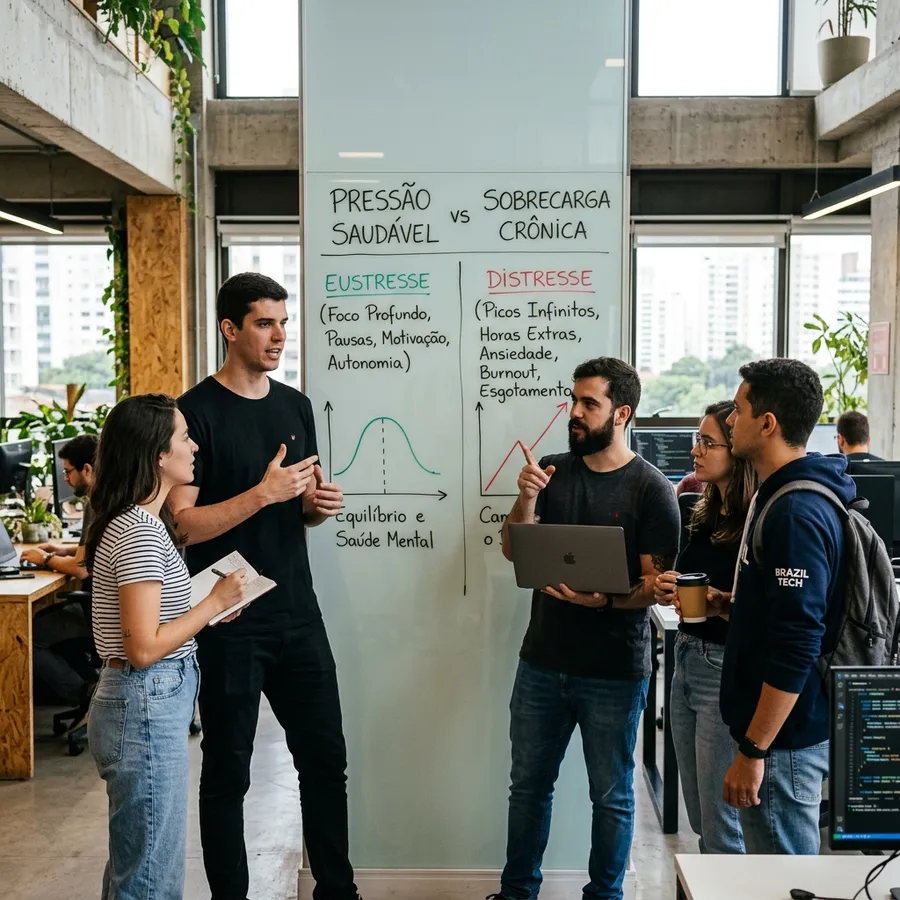
Not all workplace stress is detrimental. In fast-paced startups, an essential dividing line exists between eustress (constructive challenge) — the energizing push of a critical product launch — and chronic distress (debilitating overload).
Healthy challenge has a defined beginning, middle, and end. It comes with operational autonomy, sufficient resources, and an intentional decompression window post-sprint. Once the milestone is crossed, the team celebrates, rests, and replenishes energy stores.
Chronic overload, conversely, is an unending sprint. Concluding a chaotic release immediately precipitates another unprioritized backlog, devoid of retrospectives or acknowledgment. It feels like running a 26-mile marathon at the pace of a 100-meter dash.
💡 Diagnostic Quick Matrix:
- Healthy Pressure: Clear challenge + Autonomy + Planned recovery = High engagement.
- Chronic Overload: Unrealistic deadlines + Scant resources + Unceasing peaks = Burnout.
Exceptional leaders do not compromise on delivery standards; they deliberately sequence high-intensity execution with predictable breathing room for architectural refactoring and team recovery.
Structural management interventions: fixing systems, not just symptoms
A frequent corporate misstep is answering team fatigue with superficial perks — meditation app subscriptions or wellness workshops — while preserving chaotic workflows, unvetted scope creep, and top-down pressure.
Cultivating Psychological Safety
As demonstrated by Amy Edmondson in The Fearless Organization and validated by Google's Project Aristotle, psychological safety stands as the primary predictor of high-performing teams.
It fosters an environment where any engineer can admit confusion, flag a regression early, or challenge executive direction without fear of ridicule or retribution.
Refactoring Process Architecture
Sanity is engineered through rigorous project management: explicit scope definitions, disciplined backlog prioritization, and ruthless elimination of rework.
When leadership defines what will NOT be built in a quarter with the same conviction as active roadmaps, cognitive focus is safeguarded against fragmented paralysis.
Establishing boundaries, recovery windows, and availability protocols
Absent explicit guidelines, unwritten startup culture defaults to round-the-clock availability. Preserving team sanity requires documented working agreements actively modeled by executives.
Async-First Communication
Make asynchronous communication the default. Internal chat messages never demand instant replies. Uninterrupted deep work blocks are an organizational right.
The Right to Disconnect
Schedule non-urgent messages sent after business hours to arrive the next working morning. When executives ping late at night, teams infer they must stay online.
Equitable On-Call Rotations
Production incidents occur, but must never fall exclusively upon one hero engineer. Maintain an official, fairly compensated on-call rotation with comp time.
Honest Retrospectives
Dedicate recurring calendar slots for transparent retrospectives and collective wins. Never reduce all team ceremonies to sprint backlog status grilling.
Mandatory Vacation Usage
Prevent consecutive accrued vacation cycles. In lean teams, cross-train coverage ahead of time so teammates never take work laptops to family breaks.
Blameless Daily Alignment
Adopt short daily check-ins where stating 'I hit a blocker or needed recovery' is met with technical assistance rather than managerial condemnation.
Ethical, non-invasive metrics to track team well-being
You do not need surveillance spyware or privacy intrusion to understand organizational health. Aggregated operational signals communicate everything needed.
Ethical & Operational Indicators
- Vacation utilization rate: Percentage of team with up-to-date versus expiring vacation days.
- Commit hour distribution: Proportion of pull requests and git commits pushed late at night or over weekends.
- Anonymous pulse surveys: Two to three bi-weekly questions probing workload sustainability and roadmap clarity.
- Regretted voluntary turnover: Abrupt resignations of high-impact talent precipitated by chronic operational friction.
What NEVER to do (Ethical Violations)
- ❌ Track screen time, mouse telemetry, or keylogger activity.
- ❌ Demand exhaustive medical documentation for isolated mental health or recuperation days.
- ❌ Expose individual survey scores in open company forums.
- ❌ Weaponize pulse feedback or time-off metrics in compensation and promotion reviews.
A 90-day burnout prevention blueprint for agile startups
In lean teams of 5 to 30 people, one individual's absence reverberates across the business. Below is a 3-phase practical roadmap to operationalize sanity.
Phase 1: Baseline Audit & Initial Agreements (30 Days)
Mapping & Core Boundaries
Conduct confidential 1:1 check-ins centered on workload realities. Formalize an official team communication charter and disconnection expectations.
Phase 2: Workflow Refactoring & Deep Work (60 Days)
Eliminating Operational Chaos
Implement agile limits on Work in Progress (WIP). Transition to asynchronous updates and establish meeting-free deep work mornings.
Phase 3: Ongoing Governance & Support (90 Days)
Culture Institutionalization
Review aggregate health indicators bi-weekly. Enforce cross-coverage vacation schedules and partner with specialized mental health resources.
Sanity as an enduring competitive advantage and capital efficiency lever
Safeguarding mental health in technology ventures evolves beyond wellness rhetoric into an indispensable capital allocation strategy. In volatile, high-velocity markets, companies that preserve cognitive equilibrium compound a silent yet devastating operational edge: retaining institutional domain expertise and eliminating costly architectural rework spawned by exhausted teams. While competitors waste quarters re-recruiting engineers and untangling bug-ridden systems built under duress, emotionally grounded teams sustain high-velocity innovation and dependable value delivery.
Scaling a durable enterprise demands recognizing that a founder's strategic clarity and an engineer's creative focus constitute your most irreplaceable capital assets. Entrepreneurial success is not calibrated by accumulating personal sacrifice, but by leadership's capacity to exercise sober judgment when stakes are highest. By establishing sanity as a foundational pillar of corporate culture, startups ensure growth is not merely accelerated, but defensible, sustainable, and genuinely fulfilling for all who build it.
Referências
- WHO. Mental Health at Work. Official World Health Organization guideline on psychosocial hazards at work, global productivity losses from burnout, and recommended organizational interventions. Access WHO guidelines
- ILO. Mental Health at Work: Policy Brief. International Labour Organization technical policy brief in partnership with WHO outlining preventative frameworks for mental health risks in modern workplaces. View ILO safety portal
- GALLUP. Employee Burnout: Causes and Cures. Landmark occupational study establishing that burned-out professionals are 63% more likely to take sick days, 2.6x more likely to job-hunt, and 23% more likely to visit emergency rooms. Read Gallup study
- EDMONDSON, Amy C. The Fearless Organization. Foundational research on Psychological Safety in corporations and the core methodology underpinning Google's Project Aristotle (re:Work). Explore Google re:Work findings
- MASLACH, Christina; LEITER, Michael P. The Truth About Burnout. Pioneering academic research behind the Maslach Burnout Inventory (MBI), classifying burnout across emotional exhaustion, depersonalization, and reduced accomplishment. View on Amazon