
SCALABILITY 2026: How to grow your business with autonomy
In the current scenario, scalability has evolved. It's not just about resources, but how Agentic AI and bootstrapping models can accelerate your business without losing financial autonomy.
Scalability is a determining factor for the future of early-stage companies and startups, which depend on this factor to grow. Despite its great importance, the study of scalability is still underexplored in the market and academia.
The purpose of this article is to analyze how it is currently perceived and applied by entrepreneurs, early-stage companies, and investors from various fields in the global scenario.
What does it mean to be scalable?
The short answer is minimizing resources and maximizing results, simple as that. But let's broaden the horizons a bit below.
Scaling is growing revenue without exploding costs in the same proportion. Without scalability, a startup fails to attract investments and dies of inefficiency.
Understanding the level of scalability of a business is necessary to know its real market potential, formulate strategic planning, and also to understand possible flaws in its business model.
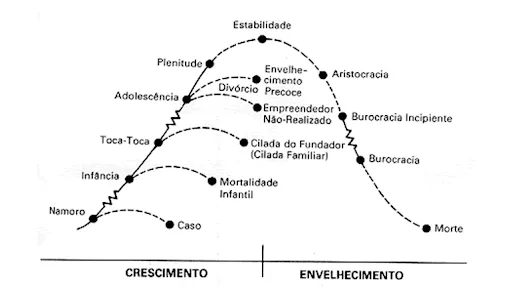
Business Life Cycle
ADIZES (1990), a researcher on company growth, compares the evolution of a company to the similar life cycle of a living being. In 2026, this concept became even more dynamic, where technology allows companies to skip stages or overcome them much faster.
He argues that the concept of the life cycle applied to living organisms can also be used to understand organizational development. Like a living being, there is birth, growth, which ends with aging and decline, or technological reinvention.
The classic stages — Courtship, Infancy, Go-Go, Adolescence, Prime, Stability, Aristocracy, Early Bureaucracy, and Death — are now complemented by continuous innovation cycles.
Ready to accelerate your life cycle?
Shinier's tools help you move out of the infancy phase and reach your prime with structure and autonomy.
Access Free ToolsHow to measure your company's scalability
Every metric must be measured, qualitatively or quantitatively, so how do we measure scalability? When we think of a large, successful company, we immediately think of a large space, with many employees and robust infrastructure, but does that mean that this company is scalable?
Let's think of the example of a construction company, with many bricklayers, helpers, and engineers, with 100 employees it is possible to build a building, and if it wants to reduce this time, it must add more people. But if this same company invests in modular construction machinery, then the same machine will do the work of 100, but if the company wants to build more buildings it will have to hire more machines.
With this simple example we realize that we can measure scalability with 3 factors:
- Production capacity: in our example, the more buildings the company is capable of building;
- Amount of resources used: number of people or machines needed to build a building;
- Time: temporal comparison of capacity and quantity.
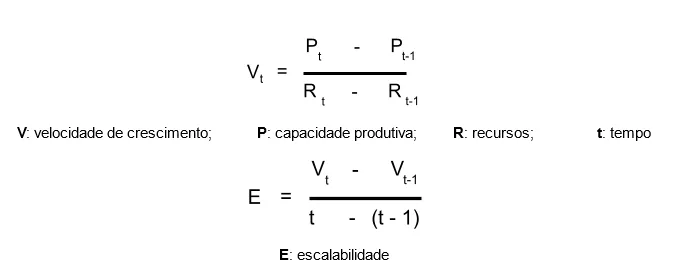
Scalability is a measure observed within the organization over time. Companies start with "slow" growth, and as time passes they gain speed, until they reach a peak, and then begin to decrease until they cease to exist.
Scalability in 2026: The role of AI and Bootstrapping
Smart Bootstrapping
Growing without relying on exhausting investment rounds is now possible. Bootstrapping in 2026 focuses on financial autonomy, where the cash flow itself sustains the scale, allowing founders to maintain full control and the strategic vision of the business.
Agentic AI (Zero-Touch)
True scaling today happens through "Zero-Touch Operations". AI agents handle end-to-end operational processes — from customer support to infrastructure management — allowing the business to grow exponentially without the need for linear staff hiring.
1. Operational & Automated
The business still depends on you, but now with "copilots". It is the phase of creating processes that can be delegated to simple AIs. If you stop, the business no longer completely stops, because basic automation keeps the gears turning while you focus on the next level.
2. Asynchronous Management
It is the moment to scale through partners and bots. You don't just hire people, but implement systems that manage tasks. The risk is diluted by operational efficiency and the low maintenance cost of these agentic technologies.
3. Strategic & Data-Driven
Here you become an architect of flows. Your role is to analyze data provided by AI to make high-impact decisions. The focus is no longer "who does it", but "how the system performs". You maintain commercial acumen, but with a 360º real-time view.
4. Exponential Scale
The dream of full autonomy. Your product is sold and delivered in a model we call Self-Scaling. To reach this phase, smart bootstrapping ensures you have the necessary margin to reinvest in disruptive innovation, whether via a platform model or global marketplace.
Startups in 2026: Where Innovation Meets AI
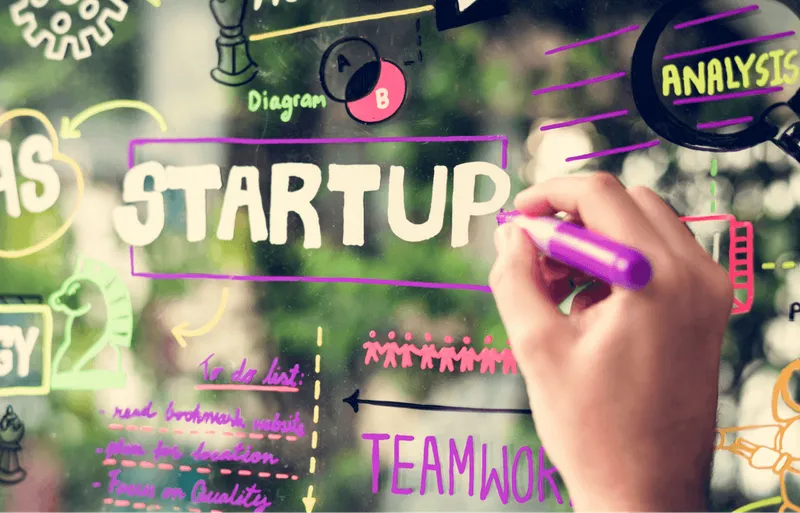
The new concept of a Startup in 2026 goes beyond just "starting something new". Today, we talk about AI-Native companies: organizations that are born with artificial intelligence at their operational core to ensure agile and extremely cheap validation.
Modern disruption isn't just about simplifying processes, but creating business models that would be impossible without agentic technology. An example is mass personalization services, which scale without increasing marginal cost.
The Maturity Metric:
A startup stops being a startup when its Product-Market Fit (PMF) becomes self-sustaining and scalable through automation, allowing exponential profits with minimal infrastructure.

From Product to Ecosystem: The Power of Platforms
In 2026, we don't just build applications; we build ecosystems. Turning your product into a platform means creating a connection environment where value is generated by the users who interact there, driven by the Network Effect.
The differentiator of modern platforms like Shinier's is Interoperability. They are not isolated islands, but hubs that connect via agentic APIs to other services, multiplying scaling possibilities without increasing technical complexity.
Platforms remove friction, providing the necessary tools for supply to meet demand in an automated and intelligent way.
Digital Franchises: Expanding through Technology
Franchising remains one of the safest models to scale validated products. The big shift for 2026 is Gestational Scalability: the ability to replicate processes, culture, and efficiency through integrated management platforms.
Transforming your operation into a franchisor requires the digital standardization of every detail. Shinier helps entrepreneurs in the technological transition, connecting your business to an ecosystem of specialized financial and legal consulting.
Pillars of the Modern Franchisor:
- Digitalization of Processes (DOP)
- Compliance with Franchising Laws
- Real-time Franchisee Control Dashboard
- Culture of Shared Success


Investing in Marketplaces: Cost Reality and ROI in 2026
Let's be realistic: building a robust marketplace in 2026 requires planned investment. High-performance software, payment architecture, and security demand capital, but the return is proportional to the global scale the model allows.
Companies like Uber and Airbnb have proven that the marketplace is the "infinite" scale model. The secret to success today is not just the software, but the Time-to-Market and network curation.
Although the breakeven point can take 1 to 3 years, models based on the platform economy allow accelerating this process through pre-validated components and serverless infrastructure with low initial cost.
Referências
- ADIZES, Ichak. Corporate Lifecycles: How and Why Corporations Grow and Die and What to Do About It. Sao Paulo: Ed. Pioneira Thomson, 1990.
- BLANK, Steven Gary. The Four Steps to the Epiphany: Successful Strategies for Products that Win.
- BANNOCK, G., R. E. Baxter, and E. Davis. The Penguin Dictionary of Economics. 7th ed. Penguin Books Ltd, 2003.
- CHRISTENSEN, Clayton M. The Innovator's Dilemma. 1997. A classic that explores how innovation can transform or destroy companies.
- COLLINS, James C. Good to Great. Discovers why some companies make the leap and others don't.
Want to scale your business?
Shinier can help your company grow sustainably and scalably.
Get in Touch