
How to protect my software? – Patents and Intellectual Property: The Definitive Guide 2026
The definitive guide to protecting your software in 2026. From IP registration to AI protection and LLM models, learn how to strategically bulletproof your business.
The Most Valuable Asset of the 21st Century
Until the 1990s, a company's value was measured by its machines, buildings, and vehicle fleets. In 2026, we live at the peak of the intangible economy. Source code, datasets, and software architecture have become the new gold. However, many entrepreneurs still believe that protecting a software is just a matter of "registering it with the patent office".
Protecting software in 2026 requires a layered vision. It's not just about preventing someone from copying your code, but ensuring no one steals your market position. While copyright protects the form (the code itself), competitive strategy protects the value.
In this definitive guide, we'll explore everything from basic Software Law to the new frontiers of protecting Large Language Models (LLMs), autonomous agents, and how Shinier helps founders bulletproof their innovations against global competition and rapid technological shifts.
The Dimensions of Software Protection
To bulletproof software, you need to act on multiple fronts, from formal registration to technical security.
Copyright
Patents
Trade Secret
Brand & UI
Data
Is your technical innovation truly secure?
Don't wait to think about legal protection until the competition shows up. Our technology and IP experts can help map your blind spots.
Request Protection AuditCode as Literature: Copyright Laws
The legal foundation for software protection in most of the world is based on international treaties. They establish that a computer program is protected by the same rights as a literary work.
This brings one advantage and one major disadvantage:
- Advantage: The protection is worldwide (via the Berne Convention) and is born the moment of creation.
- Disadvantage: It only protects the "expression" (the code written in C#, Python, etc.) and not the underlying idea.
If you build a sales CRM and register the code, and a competitor builds an identical CRM by writing the code from scratch using different logic, Copyright law won't protect you against it. That's why experienced founders know that the code is just the first line of defense.
When Does Software Become an Invention?
"You don't patent software; you patent the technical solution that uses it."
This is one of the most confusing points. In many jurisdictions (like Europe and Brazil), software "as such" cannot be patented. However, Computer-Implemented Inventions (CII) can be protected if there is a novel technical effect.
Can Be Patented
- A novel video compression algorithm
- An industrial hardware control process via IoT
- Image processing method for medical diagnostics
- Network optimization that increases energy efficiency
CANNOT Be Patented
- Purely mathematical methods
- Game rules or business methods (e.g., checkout flows)
- Simple digitalization of existing offline processes
- Presentation of information (pure UI/UX)
Moat Strategy: Porter's 5 Forces in Software
If the law protects the code, strategy protects the profit. We adapted Michael Porter's classic framework for the technological ecosystem of 2026.
Entrants
Entry barriers via patents and economies of scale.
Substitutes
The risk of low-code or alternative solutions.
Buyers
Strategic lock-in and software switching costs.
Suppliers
Dependency on Big Tech and Cloud Sovereignty.
Rivalry
Bulletproofing the competitive advantage in your core.
The New Frontier: Protecting Your Artificial Intelligence
The rise of Agentic AI has changed the rules of the game. How do you protect an agent that manages sales if the source code is just a wrapper around a third-party API?
1. Protecting Weights and Architecture: Treat your model's weights (if proprietary) as a Trade Secret. They are not "code", but they represent the distilled knowledge of your company.
2. Prompt Engineering: Register your structured prompts as literary works. By 2026, intellectual property offices already accept deposits of complex prompt libraries that condition agent behavior.
3. Fine-tuning Datasets: The dataset used to calibrate your AI must be protected by non-disclosure agreements with curators and data engineers.
The AI Inventor's Dilemma
So far, most international jurists agree: AI cannot be a copyright holder. Everything your AI generates belongs to humanity or to whoever operated it, depending on the country.
Shinier Tip:
"Always maintain substantial human review over your AI's final products to ensure you can register the result as your own."
Going Global: The WIPO Registration Process
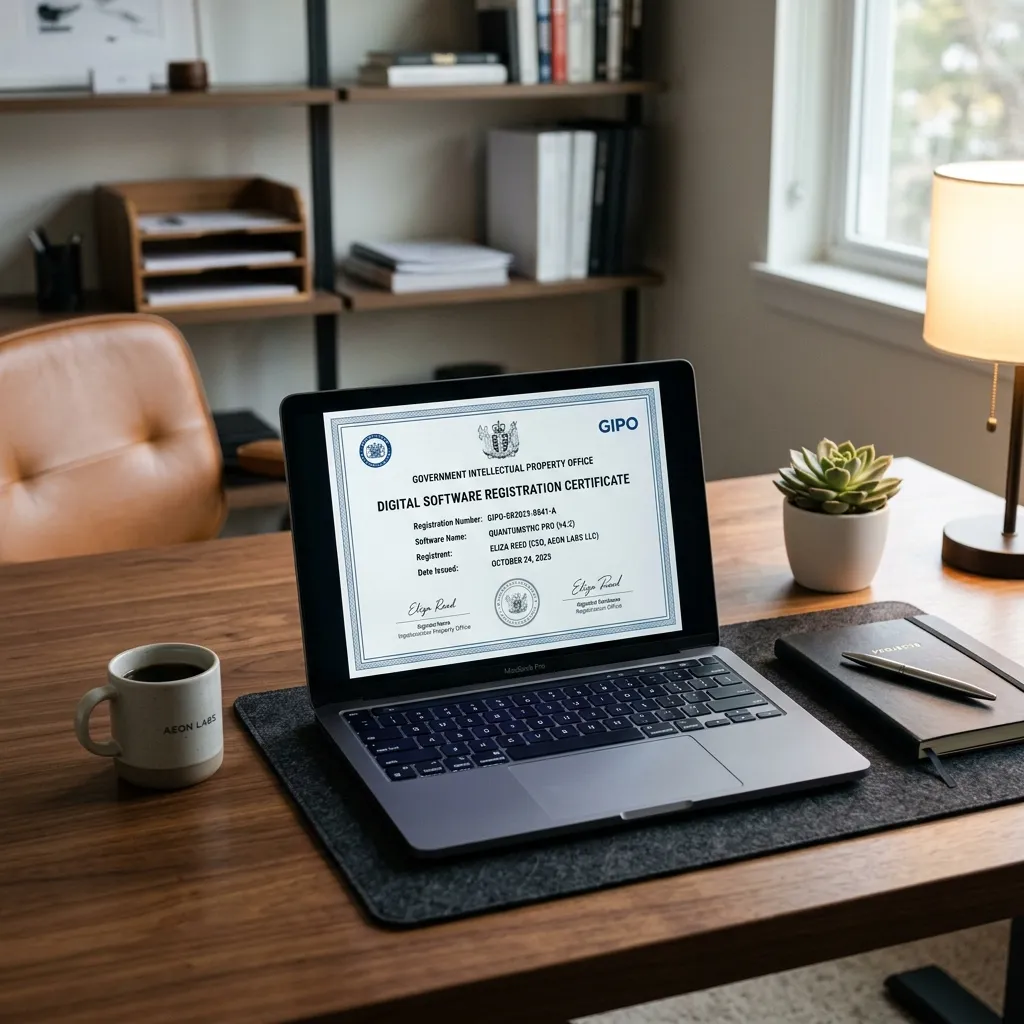
Important: If you are an international founder, you do not need to rely on localized registries like INPI (Brazil) or navigate multiple national offices. Instead, you can leverage the Madrid Protocol directly through theWorld Intellectual Property Organization (WIPO)to secure your brand and software assets across 130+ countries simultaneously with a single application.
Madrid System
Trademarks in 130+ Countries
PCT System
Patents in 157 Countries
Base Application
You must first file a domestic application in your home country's IP office (e.g., USPTO). This serves as your foundational asset.
International Application via Madrid Protocol
File a single application directly through WIPO in one language, paying a single set of fees in one currency (Swiss francs), bypassing the need to hire local lawyers in dozens of countries.
WIPO Formal Examination
WIPO checks formalities and registers your mark in the International Register, publishing it in the WIPO Gazette.
Territorial Decisions
The IP offices of the territories you designated will decide whether to grant protection within 12 to 18 months.
Culture as Armor
Strategic Open Source
Many companies fear Open Source, but in 2026, it is a defense tool. Releasing non-critical parts of the code creates an ecosystem, attracts talent, and establishes your software as the market standard.
Use licenses like MIT for lightweight components and BSL (Business Source License) for the core, allowing community use while restricting competitive use by cloud giants.
NDAs and Professional Secrecy
Before pitching at events or meetings with angel investors, use robust NDAs. At Shinier, all development contracts include full rights assignment clauses – what we build for your startup is legally yours.
Remember: a trade secret is the only thing that protects the "how-to" perpetually, whereas patents expire after 20 years.
Founder's Final Checklist
Register the source code of the stable release with the IP office at every major update.
Register your startup's trademark (name and logo) – this is more visual than the code.
Consult with a lawyer to see if your process solves a technical problem for patent purposes.
Maintain a technical decision log (prior art) for defense in legal disputes.
Implement security layers in your backend to hinder reverse engineering via web scraping or sniffing.
Protection is a Process, not an Act.
"The best code in the world is worthless if you don't own the right to the profits it generates."
Data Sovereignty: The New Defensive Moat
In 2026, code has become commoditized; the true barrier to entry is data and how it is processed on sovereign infrastructure.
Protecting your software doesn't end with compiling the binary. It extends to the persistence layer. Companies that master Data Sovereignty create what we call a "Strategic Moat".
- Homomorphic Encryption: Protect your algorithms by allowing them to process data without ever decrypting it, preventing cloud admins from seeing your logic.
- Data Lake Vaults: Structure your AI training data in encrypted silos that are legally protected as trade secrets.
- Data Residency: Keeping data in your country (or the client's jurisdiction) is not just GDPR compliance, it's a protection strategy against international industrial espionage.

Preparing Software for the Exit: The IP Audit
If your goal is to sell the startup or attract a Series A funding round, your Intellectual Property (IP) must be flawless.
Origin of the Code
Prove that every line of code was written by employees with assignment contracts or by founders. Improper use of GPL (copyleft) libraries can contaminate your software and prevent the sale.
Dependency Cleanup
Audit your `package.json` or `requirements.txt`. Software that relies heavily on proprietary third-party APIs without stable Service Level Agreements (SLAs) is viewed as a high-risk asset.
Trademark Portfolio
A company's market value is often 80% in its intangibles. Having the .com domain, the registered trademark in all relevant classes, and consolidated software registration increases valuation by up to 40%.
Internationalization and the Madrid Protocol
Software knows no borders. If your SaaS is available on the web, it's global. This brings immense jurisdiction challenges. If a competitor in Europe copies your design, how do you react?
1. WIPO: Use the systems of the World Intellectual Property Organization to extend your registration. Protection is automatic in Berne Convention countries, but formal registration facilitates injunctions.
"With the Madrid Protocol, registering trademarks and software has become cross-border. A single deposit can be the basis for protection in over 120 countries."
2. DMCA Takedowns: The Digital Millennium Copyright Act is the fastest tool to remove infringing content from global servers or from search engines like Google and Bing.
3. PCT Patent Strategy: If your software has a global inventive component, the Patent Cooperation Treaty (PCT) allows you to "reserve" the right to patent almost worldwide for a period of 30 months.
Referências
- WIPO - World Intellectual Property Organization. The Madrid System for the International Registration of Marks and the Patent Cooperation Treaty (PCT). Official guidelines for global IP protection. Visit WIPO website
- PORTER, Michael E. Competitive Strategy: Techniques for Analyzing Industries and Competitors. Free Press, 1980. Reference on the 5 Competitive Forces.
- US Copyright Office. Circular 61: Copyright Registration for Computer Programs. Official guidelines for software copyright in the US and international reciprocity.
Shall we build and protect your next big technological milestone?
Shinier unites high-performance development with a strategic market and intellectual property vision.
Talk to Experts